

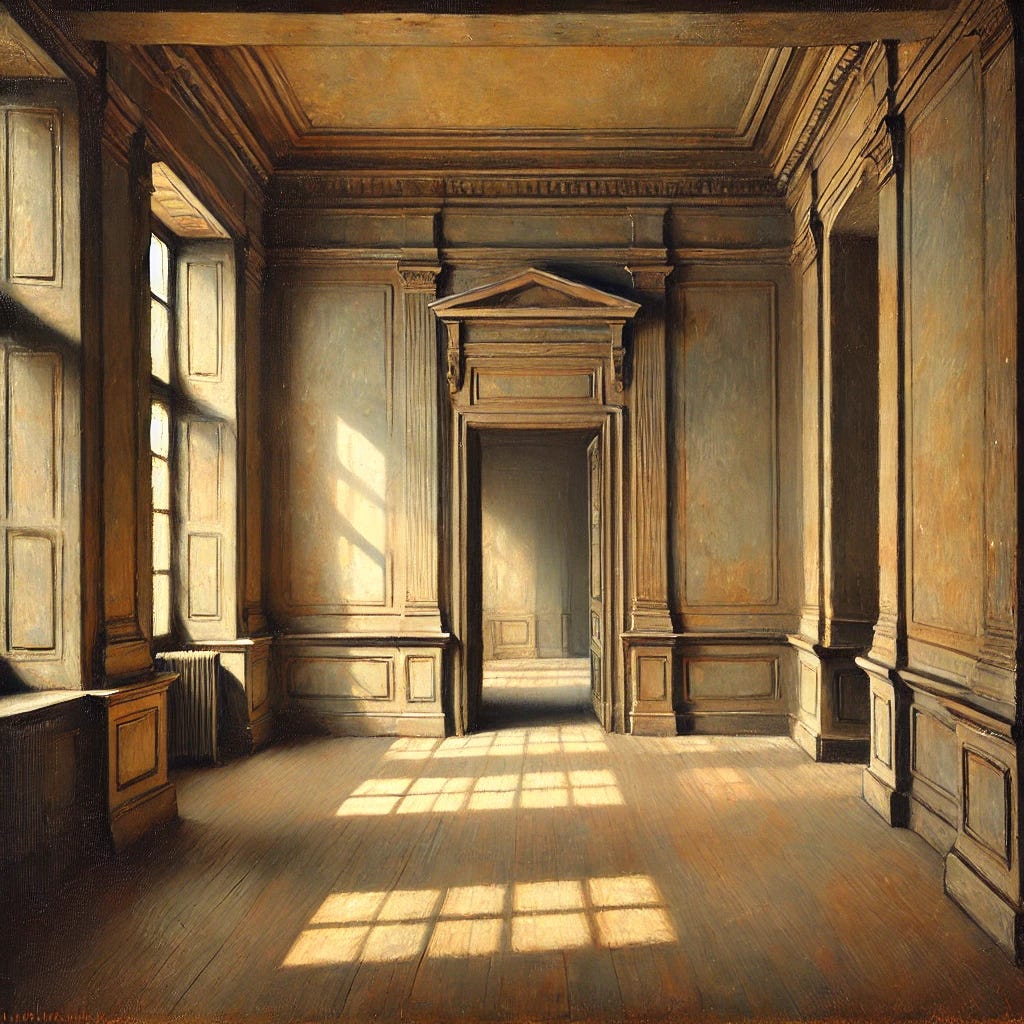
A Room Is Never Neutral
You step into a room and, at first, nothing seems to happen.
The space is familiar enough to be ignored. Four walls. A ceiling. A floor that carries the marks of use but no obvious story. Light enters from one side and settles where it always seems to settle. The air feels still, or at least quiet enough not to demand attention.
It gives the impression of neutrality.
Of waiting.
But if you stay where you are for a moment longer, that impression begins to fray.
Sound behaves differently depending on where you stand. A small movement shifts the balance of the space. Corners gather things — dust, echoes, weight. The room subtly encourages certain paths and discourages others. You find yourself standing in one place rather than another without consciously choosing to do so.
Nothing dramatic occurs.
No signal announces itself.
And yet the room is already doing work.
It holds shape. It channels movement. It contains without asking permission. You are free to move, but not without consequence. Some gestures feel natural. Others feel oddly out of place, inefficient, slightly wrong — even though nothing explicitly forbids them.
The room does not respond to you.
But it is not indifferent either.
This becomes clearer the longer you remain. Light pools unevenly. The air shifts when you cross it. The same step sounds different depending on where it lands. The space seems to remember how it has been used before. Not consciously. Not deliberately. Simply through repetition.
What felt passive now feels occupied — not by furniture or people, but by accumulated behaviour.
You are not being directed.
You are being shaped.
The strange thing is how quickly this fades from awareness. After a few minutes, the room disappears again. It returns to being background. A container. Something neutral. You move through it without noticing how it holds you, how it steers your attention, how it quietly favours some movements over others.
Most rooms rely on this forgetting.
They function best when we stop noticing them — when their constraints feel natural, when their shape no longer registers as a choice but as the way things are. We adjust without reflection. We comply without instruction. We learn the grain of the space and move along it.
The room does not need to announce its rules.
It only needs to remain standing long enough for us to adapt.
What We Assume About Structure
When we think about rooms, we tend to think backwards.
We assume intention. Someone decided where the walls should go. Someone chose the dimensions, the openings, the limits. Even when we don’t know who that someone was, we imagine them anyway. A planner. An architect. A designer. A purpose behind the shape.
This assumption is so ingrained that it rarely feels like an assumption at all. It feels like common sense.
Of course rooms are designed.
Of course systems are planned.
Of course structures exist because someone wanted them to.
When something holds its shape, when it appears stable, when it functions reliably, we instinctively attribute authorship. We look for reasons, motives, decisions. We tell stories about why things are the way they are, and those stories almost always begin with intention.
Even absence gets framed this way. If a space feels awkward or inefficient, we assume poor planning. If it feels elegant, we assume care. If it works, we assume foresight.
This habit extends far beyond architecture.
We apply it to organisations, routines, institutions, habits, technologies, even to our own lives. If something persists, we treat it as evidence of design. If it governs behaviour, we treat it as deliberate. If it resists change, we assume it was built to do so.
The alternative feels unsettling.
To accept that structure might exist without intention — that it could arise, stabilise, and endure without anyone deciding it should — threatens a deeper comfort. It removes the reassuring presence of authorship. No plan. No blueprint. No guiding hand to appeal to when the structure begins to press back.
So we default to intention, even when evidence is thin.
This doesn’t make us naïve.
It makes us human.
We are pattern-making creatures. We prefer stories with beginnings, middles, and reasons. We trust what feels chosen more than what feels accidental. And once a structure has held long enough, once it has shaped behaviour reliably, it becomes almost impossible to see it as anything but chosen.
The room, in this sense, benefits from its own stability.
Its continued usefulness is taken as proof of its purpose. Its persistence is treated as justification. The longer it stands, the more natural it feels — and the harder it becomes to imagine it any other way.
This is where the illusion begins.
Not because intention never exists.
But because we assume it always must.
And that assumption quietly determines how we relate to everything that comes next.
How Patterns Form Without a Plan
Once intention is set aside, something else comes into view.
Nothing dramatic changes. The room doesn’t reveal a hidden mechanism or declare a purpose it had been concealing. Instead, it continues exactly as it was — allowing some movements to repeat, and letting others quietly fall away.
This is enough.
Every time a step is taken along the same path, that path becomes easier to take again. Every time a corner is avoided, it becomes less likely to be used. No decision is required. No authority intervenes. The room does not enforce behaviour; it simply permits it — and permission, repeated often enough, begins to look like preference.
Over time, repetition leaves traces.
The floor wears unevenly. Sound settles into familiar patterns. Light is broken by the same surfaces again and again. What began as coincidence becomes habit. What began as habit becomes expectation. The room does not remember in the way people remember, but it does accumulate history in its shape.
This is how pattern forms.
Not through foresight, but through feedback. Each action slightly increases the likelihood of itself being repeated. Each deviation carries a small cost — not a punishment, just friction. The path of least resistance begins to assert itself, quietly and persistently.
What matters here is scale.
At the level of a single movement, nothing seems fixed. Everything still feels possible. But as movements accumulate, as behaviour repeats across time, the space begins to express a kind of consistency. Step back far enough, and a shape appears — not imposed from above, but grown from below.
This is where the room begins to resemble something designed.
The pattern is not copied. It is echoed. Smaller behaviours reinforce larger ones. Local adjustments ripple outward. The same logic repeats at different scales, even though no one instructed it to do so. What works tends to persist. What doesn’t quietly disappears.
The result feels intentional only in hindsight.
Seen from close up, the process looks ordinary — even trivial. People move where it’s easiest. Objects settle where they’re least disturbed. Sound travels where it carries best. Seen from a distance, the same process produces coherence. Order. Something that looks planned.
But nothing here required a plan.
The room didn’t need to know what it was becoming. It only needed to remain open long enough for repetition to do its work.
This is the enabling condition the room provides.
It does not tell behaviour what to do.
It allows behaviour to repeat — and that is enough to produce form.
When Stability Starts to Imitate Design
Once a pattern has held for long enough, it begins to change how it is perceived.
What started as repetition now reads as structure. What emerged gradually now appears settled. The room no longer feels like a space in which behaviour happens, but like a framework that behaviour must fit inside.
This is the turning point.
From here on, stability starts to masquerade as intention.
Because the pattern persists, it looks purposeful. Because it works, it appears justified. Because it resists disruption, it feels authoritative. The longer it holds, the more natural it seems — until it becomes difficult to remember that it ever formed at all.
At this stage, alternatives don’t vanish. They simply feel wrong.
Not forbidden.
Not impossible.
Just inefficient. Awkward. Out of place.
The room hasn’t imposed rules, but it has acquired a grain. Movement along that grain feels effortless. Movement against it feels costly. The distinction is subtle, but powerful. Behaviour begins to sort itself accordingly.
This is how stability does its quiet work.
It doesn’t demand obedience.
It rewards compliance.
Over time, the difference between what is easy and what is possible starts to matter more than the difference between what is allowed and what is not. People adapt without being instructed. They internalise the shape of the space and act accordingly. What once required attention becomes automatic.
This is where design enters the story — not as a fact, but as a conclusion.
Looking at the finished pattern, we infer intention. We imagine goals. We assign reasons. We tell ourselves that things are arranged this way because they were meant to be. The structure invites this interpretation by behaving as though it had a plan all along.
But persistence is not foresight.
What survived did not survive because it was optimal in any absolute sense. It survived because it happened to fit the conditions that allowed repetition to continue. Other possibilities were not rejected — they were simply worn down by friction.
The room now looks deliberate.
And because it looks deliberate, it begins to feel legitimate. The shape it has taken is no longer experienced as provisional or contingent. It is experienced as correct. As the way things are supposed to be.
This is how history hardens into architecture.
Not by decree, but by endurance.
Why the Room Preserves Itself
Once stability has settled into shape, something subtle begins to happen.
The room no longer merely allows repetition.
It begins to preserve continuity.
Nothing announces this shift. No boundary is drawn. No rule is introduced. The room does not become restrictive. It becomes economical. Certain movements now cost less to repeat. Certain choices require more effort to sustain. Others continue smoothly, without friction or notice.
This is how preservation emerges.
Not as intention, but as efficiency.
The room does not need to insist on its shape. The accumulated trace of past behaviour does that work quietly. Paths that have been used often remain easy to follow. Paths that were rarely taken lose their familiarity, then their convenience, then their presence. Over time, preservation becomes indistinguishable from preference.
Change is still possible.
But it is no longer neutral.
To move differently now requires energy — attention, explanation, persistence. The room allows deviation, but it does not support it. Each departure from the established pattern must overcome the accumulated advantage of what already fits. Nothing blocks the alternative. It simply asks more of it.
This is how structure preserves itself without command.
What looks like inertia is really memory held in place. The room carries forward the residue of what has worked before, not because it values it, but because preserving it costs less than reconfiguring everything around it. Continuity becomes the default state.
Over time, this preservation begins to feel like necessity.
The shape of the room is no longer experienced as one outcome among many. It is experienced as the sensible arrangement. The practical one. The one that no longer needs to justify itself. Its persistence becomes its own explanation.
But preservation is not wisdom.
What endures does not endure because it is best in any universal sense. It endures because it has already aligned with the conditions that allow it to continue. Other possibilities have not been rejected. They have simply failed to accumulate enough momentum to displace what is already there.
The room preserves what it has become.
Not because it must.
Not because it should.
But because remaining recognisable requires less energy than becoming something else.
Standing Near the Door
Nothing dramatic happens when you begin to notice what the room is doing.
The walls do not loosen. The floor does not shift. The paths that were easy yesterday remain easy today. Preservation does not pause out of respect for awareness. The room continues to hold its shape exactly as it did before.
What changes is quieter than that.
You stop mistaking continuity for necessity.
The movements that once felt natural now reveal their history. You begin to see how often they’ve been repeated, how much advantage they’ve accumulated, how little justification they still require. The room’s shape starts to look less like a rule and more like a record — a residue of what has worked well enough for long enough.
This recognition doesn’t grant freedom in any generous sense.
Nothing opens up suddenly.
Costs do not disappear.
But something does shift.
You are no longer entirely inside the room without knowing it.
Standing near the door is not an act of resistance. It is a position. From there, you can feel both sides at once: the comfort of preservation and the pressure it applies. You can sense when you are moving with the grain because it works — and when you are doing so simply because it is already there.
This is where discretion begins.
Not as rebellion.
Not as escape.
As judgment.
You become more attentive to where effort is being spent. Where continuity is being maintained out of habit rather than need. Where preservation serves stability — and where it merely serves itself. None of this makes change easy. But it makes repetition visible.
And visibility alters responsibility.
Once you recognise that the room holds its shape through use, participation is no longer neutral. Every movement contributes either to preservation or to deviation. Most of the time, preservation will still win — not because it is right, but because it is efficient.
That, too, becomes part of the judgment.
Standing near the door does not free you from the room. It simply returns something that had faded from view while you were moving automatically.
Awareness of where you are.
Awareness of what it costs to move.
Awareness of what is being carried forward each time you do.
The room does not ask you to choose differently.
It only reveals that you always were.
At the beginning, the room felt passive.
By the end, it hasn’t changed.
Only our position inside it has.
And that turns out to matter more than we usually admit.