

I. First glance — recognising the familiar
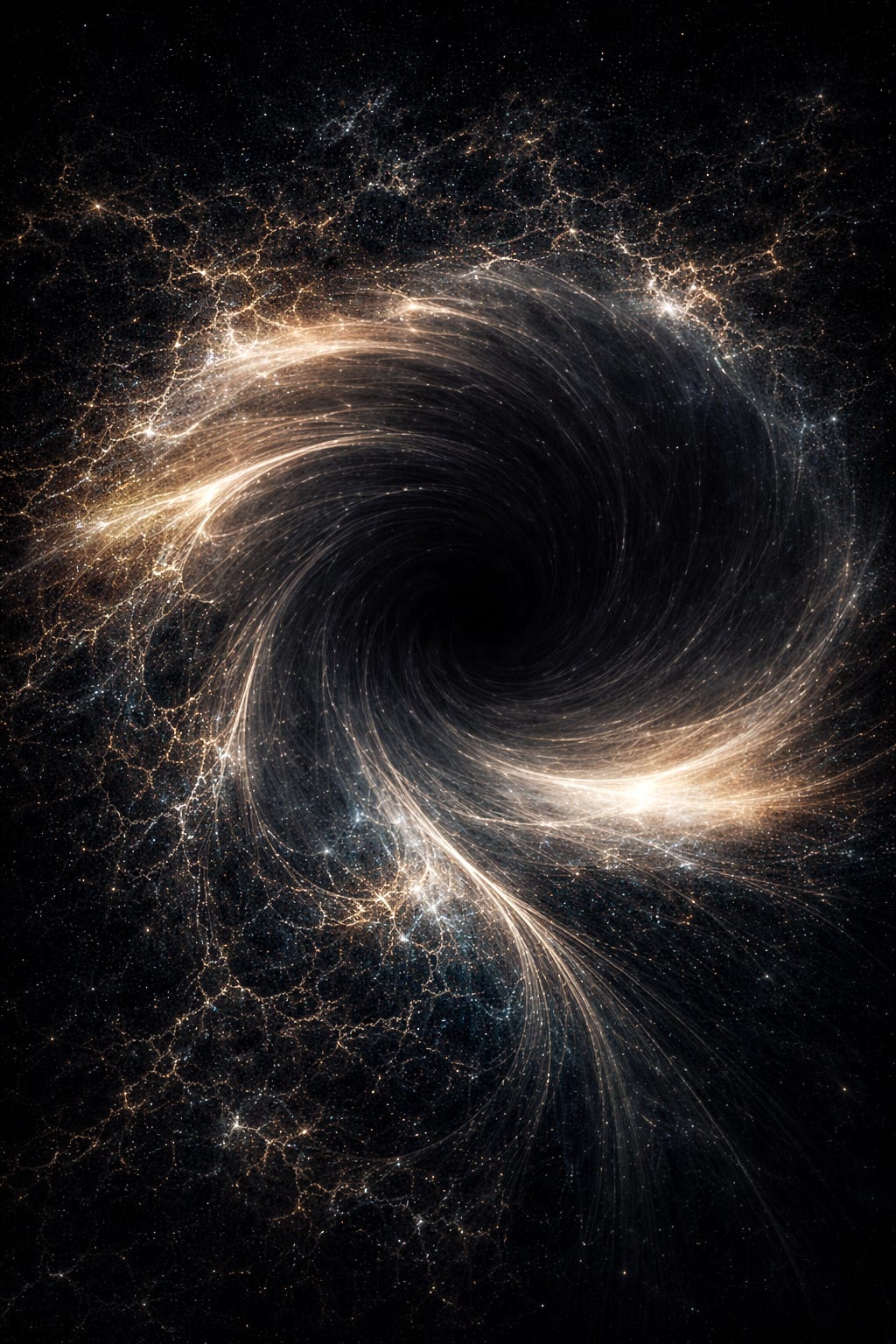
At first glance, the image feels familiar.
There is the suggestion of a form — something vaguely spherical, a region that appears set apart within a structured cosmos. A darker core. A sense of separation that invites the eye to organise what it sees into inside and outside. The mind does this almost automatically, assembling stability where it can.
That instinct isn’t a mistake; it is how we normally orient ourselves. But here, it does not quite hold.
The longer one looks, the less the image behaves like an object suspended in space. What initially appears bounded begins to reveal itself as something else entirely. There is no enclosing surface, no contained volume. Instead, what becomes visible is strain — a distortion acting through the surrounding structure rather than something placed within it.
Nothing dramatic is depicted. There is no explosion, no collapse, no violent infall. Yet the surrounding cosmos is clearly being pulled out of its familiar relationships. Patterns stretch. Lines bend. Repetition loses its regularity. Structure is drawn into a swirl — not toward a centre that can be located, but toward a condition where coherence itself begins to thin.
What might first be taken for a boundary does not behave like an edge or a wall. It announces itself only indirectly, through the way familiar relationships begin to deform. The change is perceptible but uneven. There is no sharp transition, no clean division — only a growing difficulty in maintaining the distinctions that previously felt reliable.
And where one might expect a centre, none resolves. There is no point of convergence, no final marker, no object waiting to be found. The swirl does not culminate in a thing. It fades into absence — not as a dramatic void, but as a loss of traction for the eye and for description alike.
Taken together, these details suggest something important. The image is not asking to be read as a picture of an object at all. It draws attention instead to a process — a visible transition in how structure behaves when pushed beyond familiar limits.
Before moving further, it is worth staying with that impression. The purpose here is not to replace one label with another, but to notice how readily labels appear — and how much they conceal once they do.
II. The outside — structure before disturbance
Before attending to the region of strain, it helps to look outward — not away from the phenomenon, but toward the structure that precedes it.
The surrounding space in the image is not empty. Nor is it chaotic in the everyday sense of the word. It is structured — dense with texture, repetition, and variation. Patterns fold into one another, echoing across scales. There is a sense of order here, but not one that appears imposed or designed. It feels grown rather than built.
This matters, because it quietly counters a familiar assumption. We often imagine the wider universe as diffuse or formless, with structure emerging only where matter accumulates. The image suggests something different: that structure is already present, long before it begins to strain.
The textures on display resemble processes familiar across nature — cloud formations, coastlines, biological growth, chemical patterning. These forms arise without a blueprint. Simple interactions, repeated again and again, generate complexity that is lawful yet unpredictable in detail. The result is coherence without rigidity.
What we are seeing, then, is not disorder, but pre-existing organisation. A cosmos already carrying its own internal logic, rhythms, and constraints. Nothing here suggests instability or collapse. On the contrary, this region appears balanced, self-consistent, and quietly resilient.
This framing matters for how the image should be read as a whole. When change becomes visible — and it clearly does — it is not emerging from chaos. It is emerging from structure. The distortion that draws the eye is not imposed upon a void, but acts through something already richly organised.
Holding that in mind prevents a common inversion. This outer region is not the unruly part of the picture. It is the reference frame. It is where scale, pattern, and proportion still behave in ways we recognise.
Only with that orientation in place does it make sense to attend to what begins to strain — not because this surrounding structure lacks interest, but because it establishes what will later begin to fail.
III. Where behaviour begins to change
As attention settles on the image, the first thing to register is not collapse, but strain.
The patterns that appeared stable and self-similar in the surrounding structure begin to stretch. Lines elongate. Repetition becomes uneven. The underlying organisation has not vanished, but it no longer behaves uniformly. Scale begins to matter in a way it did not before.
Nothing abrupt marks this transition. There is no sharp line where one regime ends and another begins. Instead, the change announces itself indirectly — through deformation rather than disruption. Relationships that once held effortlessly begin to thin and pull apart.
It is only at this point that a limit becomes perceptible — not as an object or a location, but as a loss of reliability. What was previously dependable begins to behave unevenly, as though the same rules are being applied under increasing tension.
In physical terms, this is closer to a change in regime than a change in position. What matters here is not where something is, but how it behaves. The image resists the temptation to dramatise this moment, and that restraint is important. In many accounts, black holes are depicted as sites of violent action. Here, the disturbance is quieter and more unsettling: familiar measures begin to lose their grip.
At this stage, it would be easy to name what is happening — to reach for established terms and stabilise the scene too quickly. But doing so would flatten what the image is showing. The emphasis here is on the transition itself, before it acquires a label.
The limit is real. But it reveals itself only through what starts to strain.
IV. A domain limit, not a surface
Once strain has set in, it becomes possible — but only gradually — to recognise a limit at work.
Nothing in the image suggests a shell, a membrane, or a physical edge that objects encounter. There is no impact, no reflection, no sense of collision. Instead, what becomes apparent is a threshold in applicability: a point beyond which familiar descriptions no longer hold in the same way.
This distinction matters. In everyday experience, boundaries tend to be tangible — walls, borders, containers. They separate regions by resisting passage. What is implied here behaves differently. It does not obstruct motion; it alters behaviour. What changes is not whether something can proceed, but whether it can still be described using the same assumptions as before.
Seen this way, the limit marks the edge of a domain rather than the outline of an object.
Before it, scale behaves consistently. Patterns repeat. Relationships remain proportionate. Measures retain their meaning. Beyond it, those same measures begin to unravel — not because the underlying rules vanish, but because applying them in the usual way no longer produces stable results.
This is why the limit is best recognised indirectly. It announces itself not through a dramatic visual cue, but through a loss of reliability. What once served as a dependable reference — distance, repetition, proportionality — starts to slip. The image reflects this by allowing structure to persist even as its coherence strains.
In this sense, the limit is less like a line on a map and more like a change in climate. One does not step across it and immediately feel something happen. Its significance becomes apparent only with hindsight, when familiar bearings quietly fail.
Treating this as a domain limit rather than a physical boundary allows the image to remain honest. It avoids turning a conceptual threshold into an object, and it preserves the central idea that what is faltering here is not reality itself, but our ability to describe it with familiar tools.
With that orientation in place, it becomes possible to attend to what remains once those tools begin to lose their grip — not to find answers, but to observe what is left when reliable reference fades.
V. Loss of scale
As strain deepens, the most striking change is not darkness, but the loss of reference.
There is no sense of accumulation or compression. Nothing appears to pile up or converge. Instead, variation begins to smooth out. Structure thins. Differences that once mattered become harder to distinguish, until familiar distinctions no longer provide reliable footing.
Scale, in particular, becomes difficult to maintain. Earlier in the image, proportions could be compared and repeated. Patterns related to one another across distance and size. Here, those relationships no longer stabilise. Without dependable scale, distance loses meaning. Without distance, sequence becomes uncertain.
What remains is not chaos in the everyday sense, but a breakdown in the tools used to describe change.
This is where it becomes useful to think in terms of wavelengths rather than objects. Much of modern physics — classical and quantum alike — relies on well-defined frequencies and scales. Time is tracked through regular oscillations. Energy is described through characteristic wavelengths. As gravitational effects intensify, those regularities stretch and drift. Measures that once anchored description no longer remain fixed.
The image does not attempt to show what replaces them. It does something more restrained. Detail does not sharpen the closer one looks; it dissolves. Differentiation weakens. The ability to say how much, how far, or how fast quietly slips away.
Notably, there is no point of convergence to be found. No visual signal marking a destination. A final point would suggest an object — something with location and properties. The image withholds that temptation. What is encountered here is not a thing, but a limit of reliable description.
In that sense, what the image presents is not a hidden answer waiting to be revealed. It is the visible expression of where description itself begins to lose traction. The image does not show what is there. It shows what can no longer be said with confidence.
VI. The “so-called” singularity
At this point, it is tempting to ask what the image is not showing.
In familiar accounts, the behaviour traced so far is expected to culminate in a singularity — often imagined as a point of infinite density where everything finally converges. The image offers no such marker, and that omission is deliberate.
The term singularity has a precise technical meaning, but it is frequently misunderstood. In classical general relativity, a singularity is not an object, nor a location that can be reached or observed. It is a signal that the theoretical framework has been pushed beyond the domain in which its equations remain well defined. Quantities diverge. Curvature becomes unbounded. The language of the theory ceases to apply.
Seen this way, a singularity is not something present within the phenomenon. It is something that happens to our descriptions of it.
The image reflects this distinction by refusing to depict a centre as a point or core. A visible dot would imply substance — something compact, final, and real in the everyday sense. Instead, coherence fades without resolution. What disappears is not matter, but the ability to assign stable properties such as position, scale, or duration.
This connects directly to the earlier loss of scale. Many of the quantities we rely on — distance, time, energy — are defined through regular cycles and repeatable measures. As gravitational effects intensify, those cycles stretch and lose coherence. When no stable wavelength can be maintained, the notion of a precise point loses meaning as well. There is nothing left to anchor it.
Calling this condition a singularity is therefore both accurate and misleading. Accurate, because it marks a real limit in our theoretical descriptions. Misleading, because it encourages the imagination to supply a final thing where there may only be a final failure of language.
The image takes a cautious position here. It neither denies the singularity nor attempts to visualise it. It treats it as a limit — not an endpoint in space, but an endpoint in reliable description. What lies beyond that limit is not shown, not because it is forbidden, but because showing it would pretend to a knowledge we do not yet possess.
Holding that distinction matters. It allows the image to remain honest without retreating into vagueness, and it keeps open the possibility that a deeper framework may one day describe what this one cannot.
VII. Hawking radiation — a leaky limit
Up to this point, the limit traced in the image might appear one-way. Once familiar measures lose their reliability, nothing seems able to return. That picture is largely faithful to classical general relativity — but it is not complete.
The idea of Hawking radiation quietly unsettles this neat separation.
In quantum terms, black holes are not perfectly black. Over extremely long timescales, they lose mass. Something escapes — not as matter emerging from a hidden interior, but as a consequence of quantum effects associated with the limit itself.
This distinction matters. Hawking radiation does not tell us what lies beyond the point where description fails. It does not resolve the singularity. It does not offer a new picture of what replaces lost scale or broken reference. What it does is remove the idea of absolute finality.
If information can leak, even subtly, then the limit cannot be treated as a perfectly sealed endpoint. The sharp distinction between “before” and “beyond” softens — not enough to restore access, but enough to prevent closure from becoming dogma.
The image accommodates this uncertainty through restraint. Nothing is shown escaping. Nothing glows or erupts. The distortion remains calm, almost indifferent. Any permeability suggested here is conceptual rather than visual — a reminder that the limits we draw belong to our frameworks, not necessarily to nature itself.
In this sense, Hawking radiation acts less as an explanation than as a correction. It does not overturn what has been traced so far, but it prevents it from hardening into a final picture. It reminds us that even the most severe limits we encounter may be provisional — tied to the level of description we are using rather than to an ultimate barrier.
The image absorbs that possibility without changing its posture. It continues to show a regime where reliable description breaks down, while leaving open — quietly, without emphasis — the possibility that this breakdown is not the last word.
VIII. Patterns, fractals, and lawful disorder
Stepping back from the image as a whole, it becomes clear that nothing new has been introduced.
No hidden mechanism has been revealed. No final explanation has been offered. What has changed is orientation — how what we are seeing is being read.
The structured regions that remain visible — their repetition, variation, and coherence — are not unfamiliar. They resemble patterns that arise naturally across many systems: chemical, biological, atmospheric, even cosmological. Alan Turing’s work on pattern formation showed how simple interactions can generate organised structure without design. Benoît Mandelbrot’s exploration of fractals revealed how form can persist across scale without settling into uniformity. Chaos theory demonstrated that lawful systems can remain deterministic while becoming effectively unpredictable.
None of these ideas explains the phenomenon traced in the image. That is not their role here.
What they provide instead is a shared language for recognising a particular kind of limit: the point at which structure continues to exist, but prediction and description lose their grip. They show that order does not require intention, and that determinism does not guarantee tractability.
Seen through this lens, the image does not depict a place where complexity ends. Nor does it present a region where lawfulness breaks down. What it shows is a regime where familiar measures no longer combine into a stable global picture, even as local structure persists.
This is why the image resists closure. The absence of a centre is not a provocation. It is a refusal to pretend that the failure of one descriptive framework has already been replaced by another. Hawking radiation hints that even severe limits may be provisional. Chaos reminds us that predictability is not a requirement for coherence. Pattern formation shows that structure can arise — and endure — without blueprint or intent.
Taken together, these ideas do not resolve what lies beyond the limits traced earlier. They justify restraint.
What the image offers, then, is not an answer but a reference — a visual anchor that holds the tension between what can be described and what can only be approached. It allows the viewer to remain oriented even as explanation thins.
IX. On stopping
What has been traced here does not end in an answer.
That is not a failure of curiosity, nor a gap waiting to be filled. It is the point at which description has reached the limit of what it can responsibly claim.
Beyond that limit, speculation may still be possible. But it would belong to a different register — one no longer grounded in the image, nor constrained by what can be shown.
The discipline of this walk has been to stop where explanation thins, without rushing to repair it. To recognise that not every boundary is an invitation to cross, and that restraint is sometimes the most accurate response a description can offer.
The image does not ask to be completed. It asks to be left intact.
For now, that is enough.