

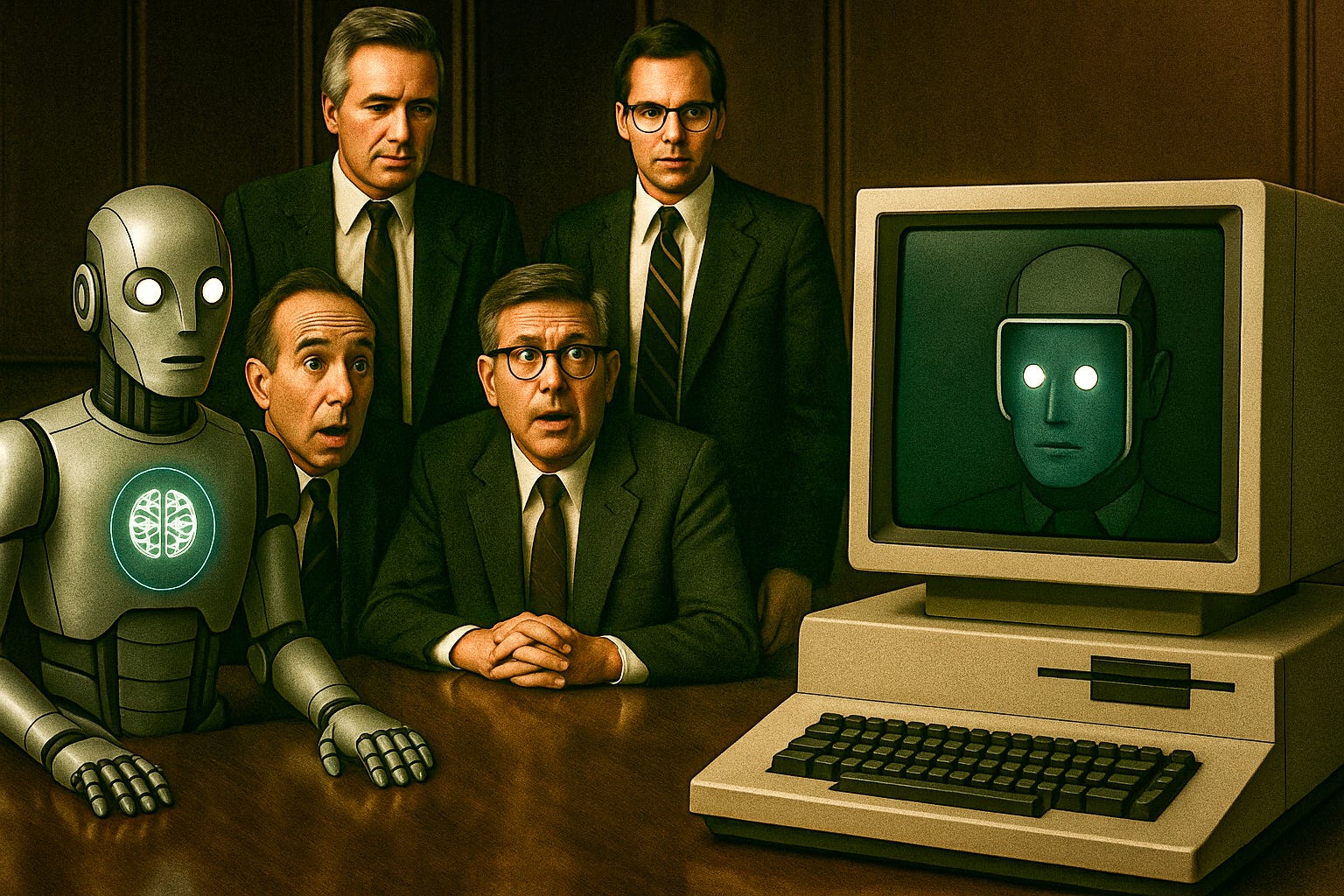
In 1985, I sat in a boardroom as something extraordinary happened. The room was filled with men in suits, serious men with years of hierarchy behind them, watching a small green screen flicker with numbers. The tool was Lotus 1-2-3, the first great spreadsheet program. A manager entered some data, pressed a few keys, and suddenly the entire table of figures recalculated before our eyes.
It was as if a magician had whispered into the machine. What had once taken an entire accounting department a week to produce was now available in seconds. People muttered about “black magic.” They weren’t entirely wrong. Something uncanny had taken place. The spell was not cast by a sorcerer, but by software.
The spreadsheet was not simply a faster calculator. It was a redefinition of power. A hierarchy had been upended. A middle manager could suddenly bypass the chain of command, produce analysis on demand, and see patterns invisible to those above him. Decisions could be made differently, faster, with fewer gatekeepers. Authority shifted—not through a vote, not through politics, but through technology.
At the time, many resisted it. They distrusted the machine, feared its errors, or clung to their own authority. Yet within a decade, spreadsheets became invisible. Today they are as ordinary as pen and paper. Nobody questions them. They simply are.
Social media followed a similar path. What began as trivial chatter—students posting photos, friends trading messages—morphed into the scaffolding of society itself. Elections, revolutions, and cultural norms are now shaped by algorithms that we treat as casually as breathing. The extraordinary became ordinary, until we forgot it was extraordinary at all.
And now, we stand before artificial intelligence. Once again, people mutter about witchcraft. But the fear this time cuts deeper. AI touches not just our workflows but our very minds. A machine can now draft an essay, write a poem, diagnose a disease, design a building, or mimic a voice. The terror is not merely that it might replace us, but that it reveals something about ourselves: how much of our so-called intelligence has always been mechanical, patterned, predictable.
This is where literature—where imagination—becomes our best guide. Because others have walked this road before us.
The Torch of Imagination: Verne and Asimov
Jules Verne, in the 19th century, was the cartographer of the possible. He gave us submarines, moon voyages, and journeys to the center of the earth. He extended what science already hinted at and cast it into story. His worlds were bold but familiar: a continuation of the laboratory, the lecture hall, the Victorian drawing room. He showed us where we might go.
Isaac Asimov, writing a century later, took the torch and turned it toward something subtler and more dangerous: who we will be when we get there. He was not dazzled by gadgets. His robots were not about gears and wires but about ethics and responsibility. The Three Laws of Robotics were not technical specifications; they were moral puzzles, forcing us to ask how we might coexist with what we create.
In Foundation, Asimov imagined psychohistory—mathematics applied to civilisations, predicting the rise and fall of empires. It was less about spaceflight than about human cycles of pride, collapse, and renewal. Asimov’s genius was to recognise that technology does not exist in isolation. It is always fused with tradition, psychology, and human frailty.
Where Verne mapped the vehicles of progress, Asimov mapped the rules of the road.
The Collision of Tradition and Technology
We are now living in Asimov’s territory. Technology and tradition are colliding every day.
The spreadsheet did not just crunch numbers—it restructured corporate hierarchies.
Social media did not just connect us—it rewired our politics and our sense of self.
AI will not just automate tasks—it will reshape what it means to think, to decide, to create.
We must not delude ourselves: technology is not an external force that “happens to us.” It is born of us, an extension of our needs, our fears, our traditions. It reflects back our strengths and our flaws. Asimov saw this clearly: robots were frightening not because of what they could do, but because of what they revealed about us.
The danger of AI is not that it is alien. The danger is that it is human, too human—a mirror of our biases, our appetites, our shortcuts. We already see it: algorithms that echo prejudice, deepfakes that exploit trust, systems that amplify outrage because outrage sells.
We must not misuse it.
The Asimovian Choice
Asimov understood something we are only beginning to face: one cannot separate humanity from technology. To do so is to misunderstand both. Humanity without technology is fantasy. Technology without humanity is nightmare.
The question, then, is not “Will AI destroy us?” The question is: “Will we misuse it, or will we discipline ourselves to use it wisely?”
This is where tradition must matter. Our ethics, our laws, our rituals of accountability must keep pace with what we build. Technology without tradition becomes chaos. But tradition without technology becomes stagnation.
The balance is delicate. And the stakes are high. We stand at one of those rare moments in history when our tools are not just faster or stronger, but fundamentally reflective. AI is not a hammer. It is a mirror.
The spreadsheet looked like black magic in 1985. Today it is invisible. AI will follow the same path. In a decade, we will not marvel at it; we will take it for granted. The question is: what will we have allowed it to become by then?
If we allow our greed, laziness, and tribalism to program it, we will inherit a future Asimov warned against—one of collapse, corruption, and wasted potential.
If we discipline ourselves with wisdom, humility, and foresight, AI could be what the spreadsheet was: not magic, but a tool that redefines power, giving us new ways to see, decide, and build.
The torch has passed from Verne’s machines to Asimov’s systems, and now to us. Whether we misuse it or master it is the story we are writing now.