

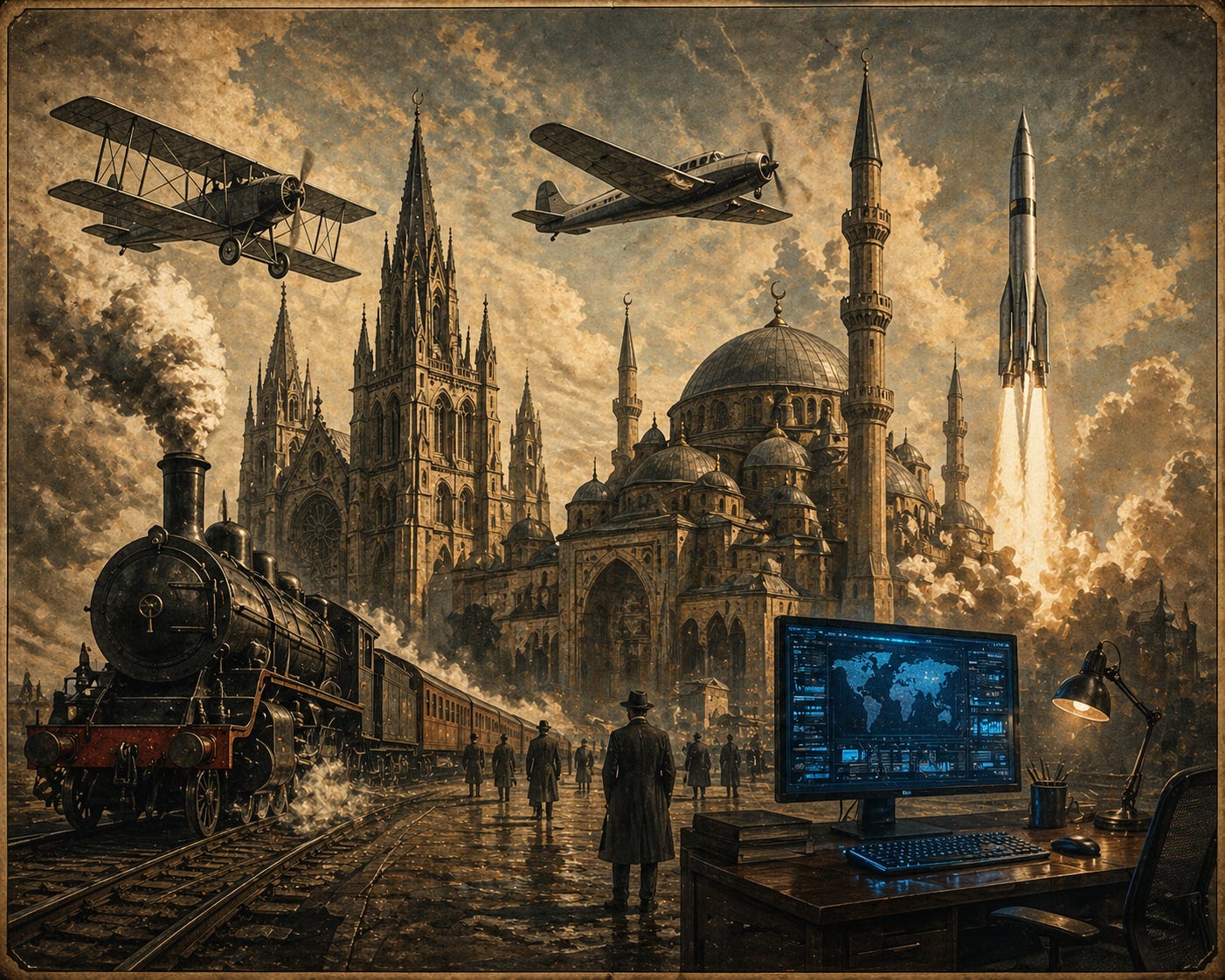
These thoughts did not arrive as a theory or a conclusion.
They emerged gradually—from observation rather than intention. From work, from conversations, from watching systems and people struggle to stay aligned in an environment that moves faster than understanding.
They are not solutions.
They are attempts to describe patterns that seem to repeat—across politics, institutions, and human behaviour—often with different language but similar outcomes.
Each of them feels incomplete on its own.
Together, they begin to form a way of looking.
The problem is not that we lack direction. It is that we have confused direction with certainty. In most fields where failure carries real consequences, progress depends on constant correction. Small adjustments, made early and often, keep the system on course. Politics, by contrast, tends to reward the appearance of certainty. And certainty, once declared, makes adjustment look like weakness. Which is usually the moment the system begins to drift.
It is tempting to dismiss religion as outdated or anachronistic. In many ways, it is. And yet, across centuries, it has done something few modern systems manage: it has held a line. Not perfectly, not without distortion, and often at significant cost—but with a continuity that resists the acceleration of the present. In a world increasingly defined by speed, fragmentation and constant adjustment, that resistance begins to look less like weakness and more like function. Not as a solution. But as a counterweight.
Modern systems do not fail for lack of direction. They fail when correction outruns continuity—or continuity resists correction. The task is not to choose between them, but to hold both without letting either dominate.
We tend to treat others according to our own idea of normal. When they don’t respond as expected, the gap is often read as resistance, weakness, or intent. But the issue is often simpler. The model is wrong. What appears as failure from one perspective may be limitation—or difference—from another. The danger begins when we stop adjusting the model and start labelling the person.
I am not religious, and I do not align myself with any particular political direction.
That is not a position of certainty, but of caution.
The patterns described here appear across belief systems and ideologies alike. They are not confined to one side or another, nor resolved by choosing between them.
If anything, they suggest something less comfortable:
That stability depends less on what we believe, and more on how willing we are to adjust, to hold a line where necessary, and to question the models through which we interpret both systems and people.
These thoughts are not final.
They are simply where the picture currently holds.