

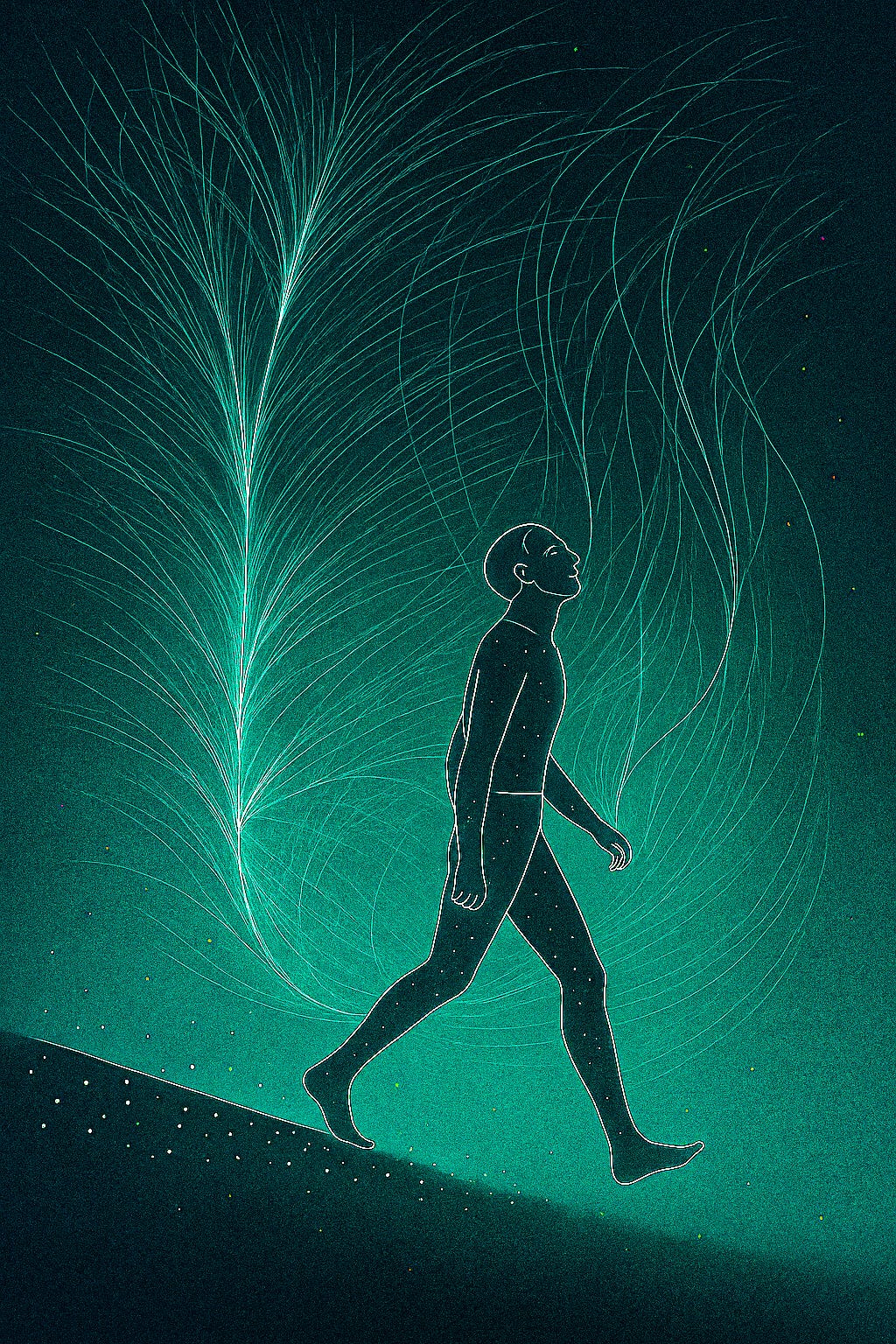
Human progress has always been entropic in its effects: each solution expanding the space of consequence faster than intuition can contain. Artificial intelligence and quantum computing are not departures from this pattern, but responses to it — tools designed to operate where human cognition reaches its natural limits.
Seen this way, the challenge before us is neither mysterious nor unprecedented. It is structural.
Scale Changes Everything — Except Responsibility
Artificial intelligence, machine learning, and quantum computing do not introduce new forms of agency into the world. What they introduce is scale: speed, reach, and consequence that exceed the limits of individual intuition.
At scale, actions propagate further than their originators can easily perceive. Cause and effect become distributed across time, systems, and institutions. Feedback loops tighten, while accountability becomes harder to trace.
This can feel like a loss of control. It is not.
What changes is not responsibility, but the conditions under which responsibility must be exercised.
What Has Not Changed
Despite the language often used to describe these systems, nothing fundamental has shifted:
Values do not emerge from computation.
Goals are not generated by models.
Responsibility cannot be delegated to optimisation processes.
Ethics do not become probabilistic.
Artificial systems act within constraints that humans define — even when those constraints are expressed indirectly through data, objectives, or reward functions. The fact that outcomes may be surprising does not make them autonomous.
Surprise is not agency.
The Illusion of Inevitability
As systems grow more complex, a subtle narrative often appears: inevitability.
Phrases such as “the system decided” or “the model concluded” suggest that outcomes are the natural consequence of intelligence rather than the result of design choices. This framing is appealing. It reduces discomfort and diffuses responsibility.
But inevitability is not a property of technology. It is a property of language.
When inevitability takes hold, oversight weakens. When oversight weakens, accountability erodes. What appears to be a technical problem is, in fact, a narrative one.
Governance Is Not Control
Governance, in this context, is often misunderstood. It is not about restraining machines, nor about imposing moral will on systems. It is about structuring human responsibility under conditions of scale.
Mature governance assumes fallibility. It expects error, drift, and unintended consequence — and designs mechanisms to detect, correct, and adapt. This is not weakness; it is realism.
Well-governed systems do not depend on perfect foresight. They depend on institutional capacity to respond when foresight fails.
Transparency Without Illusion
A common demand placed on advanced systems is total explainability. While transparency is essential, full intuitive comprehension is often unrealistic at scale.
This does not absolve responsibility.
Oversight does not require that every internal process be reducible to human intuition. It requires that outcomes can be monitored, constraints audited, incentives examined, and corrective action taken.
Responsibility is procedural before it is explanatory.
Why Delay Is Not Neutral
Calls to slow or halt development are often framed as caution. In practice, delay rarely prevents adoption; it displaces it.
Knowledge is globally transferable. Capability travels faster than consensus. Systems developed without governance elsewhere do not remain elsewhere.
The question is not whether these tools will exist, but whether the institutions surrounding them will mature in step.
The Real Test Ahead
Artificial intelligence and quantum computing do not test whether machines can become more like humans.
They test whether humans can remain accountable when outcomes no longer feel human-scale.
They test whether institutions can sustain responsibility without relying on intuition alone. They test whether language can remain precise under pressure. They test whether we can resist the temptation to externalise agency when complexity rises.
These are not technical challenges. They are civic ones.
Closing
AI, machine learning, and quantum computing are not mirrors of ourselves, nor rivals to be feared. They are amplifiers of human intent — and of human limitation.
The future they shape will not be decided by systems that calculate faster than we can think, but by whether we are willing to remain responsible when the consequences of thinking become harder to see.
This three-part series is not an argument for fearing artificial intelligence or quantum computing, nor an attempt to predict their ultimate impact. It is an effort to clarify what these technologies are, how they operate at scales that exceed human intuition, and why our responses to them often say more about us than about the systems themselves. AI and quantum computing do not introduce intention, agency, or values into the world; they amplify those already present. The central challenge, therefore, is not whether machines will become more human, but whether human institutions, cultures, and responsibilities can mature fast enough to remain proportionate to the scale they have created.