

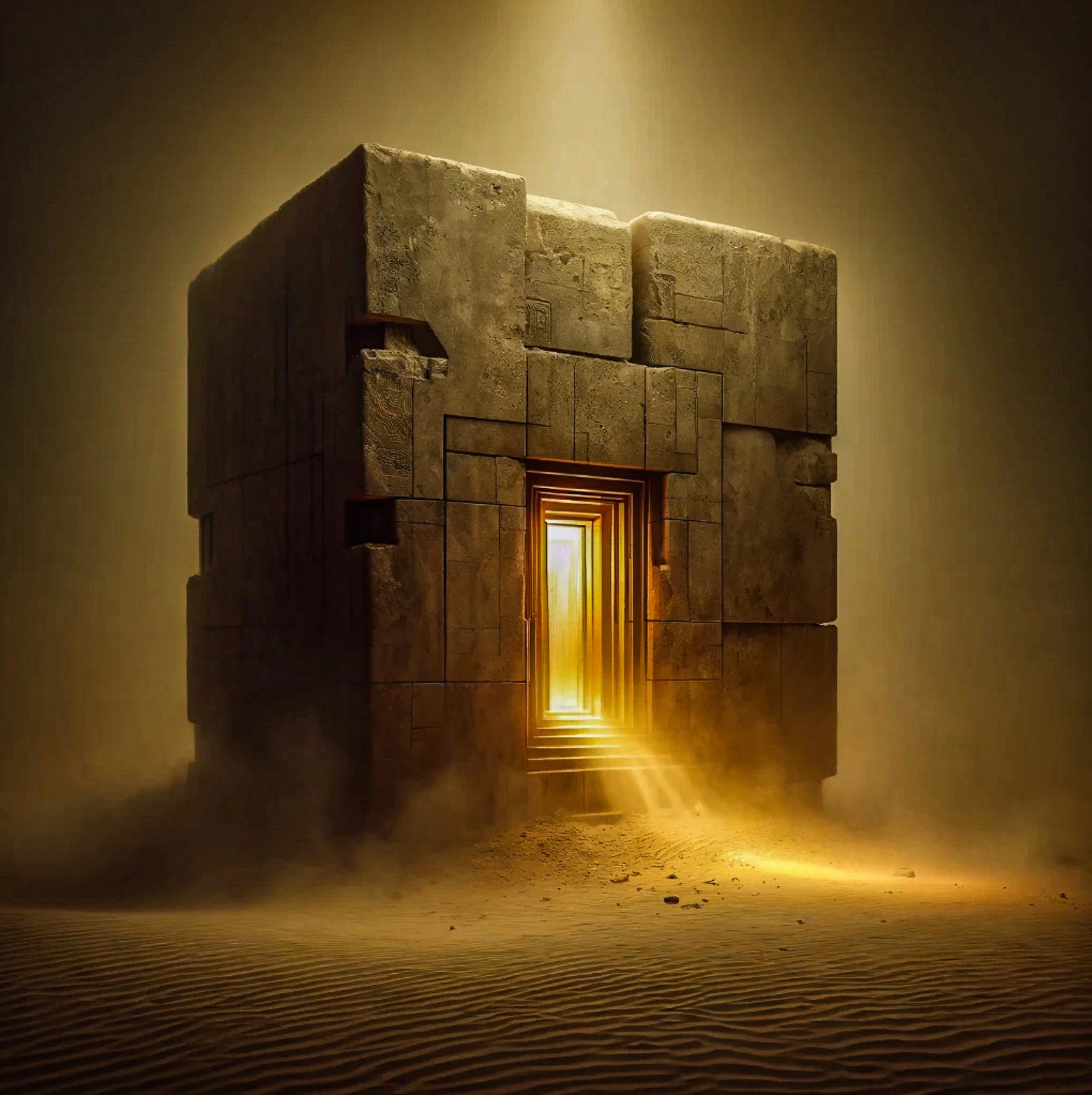
Introduction: A Mindset, Not a Message
This isn’t a guidebook. It’s not a manifesto. It’s not even an argument.
What you’re holding is an invitation—to think differently, or at least to loosen the bolts on how we think at all.
Six Doors to the Unspeakable doesn’t aim to disprove religion, replace science, or solve the world’s mysteries. It’s about walking through some of the rooms we’ve built—myth, belief, reason, doubt, paradox—and asking what they’re made of.
It comes from a particular place: a mindset that refuses to stop at the surface. Deep suspicion of dogma. Deep respect for wonder. Written by someone who’s been through fire and fog—recovery, business and crises, tradition and rebellion—and who still believes, perhaps irrationally, that there’s meaning out there. Not one meaning. A pattern. Music beneath the noise.
You won’t find answers here. You might not even find what you’re looking for. But if it makes you pause—if it sharpens your questions or shifts your gaze slightly off-center—then it’s done what it came to do.
We’re all wired differently. We walk different paths. Some of what’s here will resonate. Some won’t. That’s the point.
This isn’t the way. It’s just a way. A flashlight on the wall of a cave we’re all still crawling through. A sketch of a cathedral that will never be finished.
And maybe that’s where the beauty lies.
Door I. Where Belief Begins
Before science, before books, before kings and calendars—there were stories.
And in those stories, humans did something extraordinary: we explained the unknowable. Not with equations, but with myths. Not with testable facts, but with metaphors that echoed across mountains and deserts.
The earliest myths weren’t entertainment. They were survival tools. If the rain god was angry, you didn’t just stay dry—you performed the ritual to fix it. If ancestors whispered in dreams, you listened. Myth wasn’t fantasy. It was reality’s best available operating system.
From Mesopotamia’s fertile floodplains came the first great cosmic dramas. The Enuma Elish: gods born from chaotic sea, order emerging from violence, humans made from the blood of a defeated god. Genesis would later echo it—more sanitised, more monotheistic, more edited. But the DNA remained.
India’s Vedas, arguably older still, told of a universe born not from divine command but from sacrifice. The god Purusha, cosmic man, dismembered to create the world. Creation wasn’t clean. It was messy, brutal, sacred.
Egypt had Ra emerging from the waters of Nun, alone in the dark. Greece gave us Chaos—literally the nothingness from which everything came. The Polynesians spoke of Rangi and Papa, sky father and earth mother, separated by their children to let in the light.
Different geographies, different cultures—same patterns. Darkness becomes light. Chaos becomes cosmos. Unity fractures to birth creation. And somewhere in that fracture, humans appear: uncertain, anxious, asking questions with fire in their eyes.
Why are we here? Where did we come from? What happens when we die?
The answers weren’t carved in stone yet. But they were spoken by firelight, in symbols and song. Passed from mothers to children, from shamans to hunters. These weren’t “false” beliefs. They were the first language of meaning.
Today we dismiss many of them as superstition. But what if they were more like early models? Before we could code the stars with mathematics, we carved gods into them with imagination. Before equations, there were stories. Before prediction, there was pattern.
This is where belief begins. Not in churches or temples—but in the aching need to explain the inexplicable.
The first door stands open. The next room is full of fortresses, schisms, and holy wars. Shall we enter?
Door II. The First Great Split – When Belief Divided Itself
If the earliest myths were open fires shared across generations, the next phase was more like building fortresses.
Belief became territory. Fluid stories hardened into doctrines. Oral traditions were pinned down into scripture. And once something is written in stone—be it tablets, scrolls, or holy books—it stops evolving quite so easily.
Judaism introduced a radical idea: one God, one chosen people, one covenant. It broke from the older, more flexible polytheisms of the region. Not a pantheon—a singularity. But even here, early Jewish thought wasn’t monolithic. The Hebrew Bible contains tensions, contradictions, layers of theological development.
Christianity emerged from this Jewish root but quickly spun off in a dozen directions. The teachings of Jesus became gospel, but whose gospel? The first centuries were full of competing Christianities—Gnostics, Ebionites, Pauline sects. Eventually, the version backed by imperial Rome won the theological war, but not without fractures: East vs. West, Catholic vs. Orthodox, and later the Protestant Reformation, which shattered the Church into hundreds of pieces.
Islam, rising in the 7th century, offered clarity—a final prophet, a final revelation. But again, unity proved elusive. Within decades, political and spiritual tensions birthed the Sunni-Shia split. Mystical Sufism bloomed within the orthodoxy, challenging rigid interpretations with poetry and personal union with the divine.
Hinduism—if it can even be called a single religion—represents an ecosystem of beliefs. It absorbed indigenous deities, philosophies, and rituals into a vast, evolving framework. Yet even it split into sects worshipping Vishnu, Shiva, the Goddess. Philosophical schools argued over dualism, non-dualism, the nature of self.
Buddhism, born as a reaction to Hindu ritualism, quickly developed its own branches. Theravada sought the monk’s path. Mahayana emphasised the Bodhisattva. Vajrayana introduced tantra and ritual. In Japan, Zen stripped everything down to silence and paradox.
What began as attempts to describe the sacred soon became maps for control, identity, and power. Theology became law. Belief became boundary. Wars, crusades, inquisitions—not just between faiths, but within them.
And yet, beneath all the conflict, a shared thread persisted: a yearning for transcendence. The same firelight, now refracted through stained glass and minarets.
This was the first great split—not away from meaning, but toward competing meanings. Not away from spirit, but into tribalised spirit. And it would lay the groundwork for a second fracture—when we stopped fighting over gods and started doubting them entirely.
The second door closes behind you. The next is made of brass, logic, and ticking clocks.
Door III. The Second Split – When Reason Replaced Wonder
There was a moment—sometime around the 17th century—when we decided the world didn’t need to be sacred to be understood.
Wonder was replaced by curiosity. Mystery by mechanism. What had once been explained through gods and myths was now being dissected under candlelight by the first modern scientists. The world was no longer a spiritual drama—it was a puzzle to be solved.
Descartes gave us dualism: mind and body, subject and object. He trusted thought more than sensation. “I think, therefore I am” was a philosophical earthquake. It shattered the unity between human and world. It said: you are not part of nature—you are a mind watching it from the outside.
Then came Newton, with his universal laws and celestial mechanics. Gravity, motion, cause and effect—mapped and measured. The universe, once alive with spirit, now ticked like a great cosmic clock. Predictable. Ordered. Mathematical.
The Enlightenment saw this as liberation. Superstition was cast aside. Truth could be tested. The sacred was demoted; reason enthroned. Humans, for the first time, imagined themselves capable of mastering the universe through logic alone.
And to be fair—it worked. Vaccines, steam engines, democracy, electricity, telescopes. The scientific method proved itself powerful and transformative.
But something else was quietly exiled in the process: meaning.
With the sacred dismantled, the cosmos became indifferent. The Earth was not the center. The heavens were silent. Time was linear. Death, final. The myths that once made us part of a greater story were replaced by graphs and formulas. Useful? Yes. Soulful? Not so much.
The spiritual became personal, then optional, then quaint. Mysticism was mocked. Poetry, relegated. The heart was ruled by the head.
Some rebelled. The Romantics mourned the death of the divine. Artists, mystics, and madmen whispered that the world was more than what could be measured. But the march of progress was loud—and rationalism had louder boots.
The Second Split wasn’t just science breaking from religion. It was a deeper fracture: the severing of meaning from knowledge.
The third door stands open. The next chamber is unstable. Equations start to shake. Particles refuse to behave. And science itself begins to wonder if it went too far.
Door IV. The Bridge – Where Mind Meets Matter Again
The further science advanced, the stranger it became. And eventually, it looped back on itself, like a snake swallowing its tail.
In the early 20th century, Einstein offered a theory so elegant it re-enchanted the cosmos. Time and space weren’t fixed—they bent, curved, flexed. Gravity wasn’t a force—it was geometry. His General Theory of Relativity turned the universe into a dynamic, living fabric.
But Einstein was haunted by quantum mechanics, which undermined everything he stood for. “God does not play dice with the universe,” he insisted. But dice were rolling.
Quantum theory revealed a world where certainty crumbled. Electrons flickered in and out of being. Light acted as both wave and particle. The observer became part of the outcome. Reality, it seemed, wasn’t fixed—it was participatory.
And then came the atom bomb—a chilling reminder that theory has consequences. Humanity had split the atom and split the world. Scientific brilliance without philosophical depth gave us power without wisdom. Oppenheimer quoted the Bhagavad Gita: “Now I am become Death, the destroyer of worlds.” Myth and physics, reunited—but in horror.
The bomb didn’t just end a war. It ended certainty. If science could do this—could fracture reality itself—then maybe the Newtonian dream of perfect prediction was the real illusion.
And then came the intellectual reckoning: Chaos Theory.
In deterministic systems—systems governed by clear, repeatable rules—it found irreducible unpredictability. Tiny causes with massive effects. Weather, ecosystems, economies—all more complex than our equations could handle. The Newtonian clock didn’t just tick irregularly. It shattered.
Turing patterns showed how order could emerge spontaneously from chaos—stripes on zebras, spots on leopards, the spiral of a nautilus. Self-organisation without a blueprint. Mandelbrot’s fractals revealed infinite complexity at every scale—coastlines, clouds, blood vessels, all exhibiting the same recursive structure no matter how deeply you zoomed.
Chaos Theory fell between disciplines—too mathematical for biologists, too messy for physicists—and so it was often sidelined. But it explained what the others couldn’t. It became the condition for understanding what came next. Quantum indeterminacy made sense once you accepted that deterministic systems could be fundamentally unpredictable. String theory’s dimensional complexity became navigable once you stopped demanding neat causality. Spacetime’s curvature fit naturally into a universe where structure emerges from turbulence, not decree.
The clock hadn’t just cracked. It had never been a clock at all.
And so the bridge began to appear—between ancient mysticism and modern science. Between myth and math. Between the heart and the head.
David Bohm spoke of an “implicate order”—a hidden layer of wholeness behind the fractured surface. Carl Jung explored archetypes, synchronicity, and a collective unconscious that mirrored mythic patterns. Gregory Bateson and Norbert Wiener introduced systems and cybernetics—feedback, interconnection, ecology of mind.
Meanwhile, neuroscience mapped the brain but struggled to explain the mind. Consciousness remained elusive—irreducible, inconvenient. A ghost in the machine.
And language? Language became the new gravity. Stories shaped perception. Narratives became operating systems. Information theory said: reality might be made of bits, not bricks. Atoms gave way to algorithms. Code replaced clay.
We weren’t just describing the world—we were creating it, live, in the act of observation, intention, imagination.
The bridge was built not from new facts, but from a new humility. A willingness to admit that mystery might not be ignorance—it might be architecture.
In this chapter of the human story, wonder crept back in—not through pulpits, but through paradox. Not through commandments, but through complexity.
The fourth door is not a corridor—it’s a suspension bridge, swaying in the wind. Ahead: those who dared to cross it, and what they brought back.
Door V. The Modern Unifiers – Stitching the World Back Together
Across the last century, a strange group of thinkers began to appear. Not prophets. Not professors in the traditional mould. Bridgers—people who saw the disconnected pieces of myth, science, psyche, and story and dared to ask: what if these were never meant to be separate at all?
Yuval Noah Harari reframed history not as a march of facts, but as a web of shared fictions. Money, gods, empires, laws—all built on collective stories. Not falsehoods, but functional myths. Belief as infrastructure.
Douglas Hofstadter revealed how consciousness might be a “strange loop”—a self-referential system, recursive and paradoxical. His work blurred the lines between math, art, and mind. Between structure and soul.
Iain McGilchrist stepped forward with a thesis that our divided brain shapes a divided world. The left hemisphere—linear, literal, analytic—had overtaken the right—holistic, metaphorical, intuitive. Not neurological trivia. Civilisational critique.
Rupert Sheldrake, the controversial biologist, proposed that the universe remembers. His theory of morphic resonance—fields of form and habit—infuriated materialists but intrigued mystics. Maybe memory isn’t stored in the brain alone. Maybe nature, too, has memory.
These modern unifiers didn’t agree on everything. But they shared something rarer: a willingness to walk between disciplines, to hold complexity without collapsing into certainty. To stitch together a narrative spacious enough for neurones and Nirvana.
This is the moment when the tools of science were turned inward—not to conquer, but to question. And in doing so, they began to circle back to what shamans, poets, and monks had been whispering for centuries: that all things are connected, and the connections are the real story.
The fifth door opens into a study filled with books, cables, incense, and quantum equations. The sixth and final room is empty—until you enter it.
Door VI. Your Own Theory – Fragments, Fire, and the Ongoing Question
You’ve walked through the myths, the schisms, the equations, the bridges. You’ve seen how stories become doctrines, how science becomes dogma, and how meaning evaporates when we cling too tightly to certainty.
And now—this is where it lands. Not in a final answer, but in continuing questions.
I’m a seeker—someone allergic to dogma but addicted to understanding. Someone who refuses to stop at easy answers or well-lit exits. From recovery to geopolitics, from ancient texts to modern systems, I’ve been pulling on the threads of pattern, power, and meaning for decades. I’ve watched systems build and collapse—from inside them and outside. I’ve seen how belief can both save and destroy, how science can both liberate and dehumanise.
The universe doesn’t owe us clarity. But still—I reach. Not for comfort. Not for conversion. But because there has to be more. Something deeper. Something behind the veil of both religion and reason.
What I’m building isn’t a theory. It’s a way of standing. A practice of orientation in complexity. One that holds paradox without trying to resolve it. One that traces patterns without demanding they resolve into answers.
The pattern I keep finding: the primal questions we’ve always chased—the ones behind gods, equations, rituals, and revolutions—can’t be answered definitively. They can only be approached. Through myth. Through math. Through meaning. Through memory. Through the willingness to stay uncertain while still moving forward.
And here’s where it gets interesting: we’ve now built systems—AI systems—that can navigate complexity at scales we can’t. They can hold more patterns, surface more connections, compress more data than any human mind. They work best exactly where human cognition starts to fail: when language and knowledge at scale outrun our ability to synthesise it.
But here’s what they can’t do: they can’t tell us what matters. They can’t provide judgment, accountability, or direction. They’re superb assistants for navigating tricky seas—but the course is ours to set.
This is why the historical arc matters. If we don’t understand the rooms we’ve built—myth, fragmentation, reason, chaos, synthesis—we won’t know what we’re asking AI to help us navigate, or why human judgment remains non-negotiable.
What I’m working with, then, is this: orientation matters more than answers. Pattern recognition matters more than certainty. And the right relationship between human judgment and computational assistance might be the most important framework we build in this century.
Not a conclusion. An ongoing calibration.
And in those rare moments, when all six doors seem to align and the unspeakable flickers into view—it’s not an answer. It’s an invitation.
An invitation to keep seeking.
To stay human.
To keep asking better questions.
Even when we know we’ll never get the final answer.
Epilogue: A Compass, Not a Conclusion
What you’ve walked through isn’t a finished argument. It’s a search pattern.
A way of looking at the world that assumes nothing is meaningless and everything is connected—even when it doesn’t make sense yet. A way of holding myth and math, pattern and paradox, without forcing them into premature resolution.
At its core, this approach rests on a few quiet convictions:
Nothing arises in isolation. Every god, law, particle, and poem is born from context. Understanding requires tracing backwards through the rooms we’ve built.
All systems fracture. Belief, science, society—they all split eventually. And the cracks are where truth leaks in.
We shape the world by the questions we dare to ask. And by the stories we tell to survive the answers.
Certainty is comforting—but illusory. Mystery is maddening—but essential. The willingness to stay uncertain while still moving forward might be the most valuable skill we have.
Our search will never end. And that is not failure. It is what makes us human.
This isn’t the end of a theory. It’s the midpoint of a mindset. What happens when you stop asking who’s right and start asking what’s missing. When you stop dividing disciplines and start tracing their overlaps.
Your version will look different than mine. It should. Because the ultimate aim isn’t to define truth—it’s to deepen our relationship to it. To make peace with the unspeakable. To keep building a cathedral of meaning we know will never be finished.
And in this moment—when AI can navigate complexity at scales we can’t, when information outpaces synthesis, when certainty has become a weapon—this kind of orientation matters more than ever.
Not because it gives us answers.
Because it keeps us asking the right questions.
Maybe that lifelong act of seeking is the most sacred thing we do.