

After publishing four pieces in the Cosmic Kitchen Series — the Teaspoon, the Whisk, the Sieve, and the Kitchen Scale — I found myself stepping back from the counter. Not to rearrange the utensils. Not to argue with them. But to ask the question that had been lurking behind the apron the whole time:
Where did the taste come from?
The one that guides the utensils before the cooking even begins.
Because if the Kitchen is a metaphor for the universe, and the utensils describe how reality behaves, then something must sit above all of it. Something that allows a universe to unfold, coherence to stabilise, meaning to arise, awareness to taste, and measurement to fail spectacularly.
In short:
The Chef’s Hand.
Or if you prefer to keep the theologians from hyperventilating:
The Condition.
A pre-physical taste that precedes the Kitchen itself.
Let’s climb out onto the balcony for a better view:
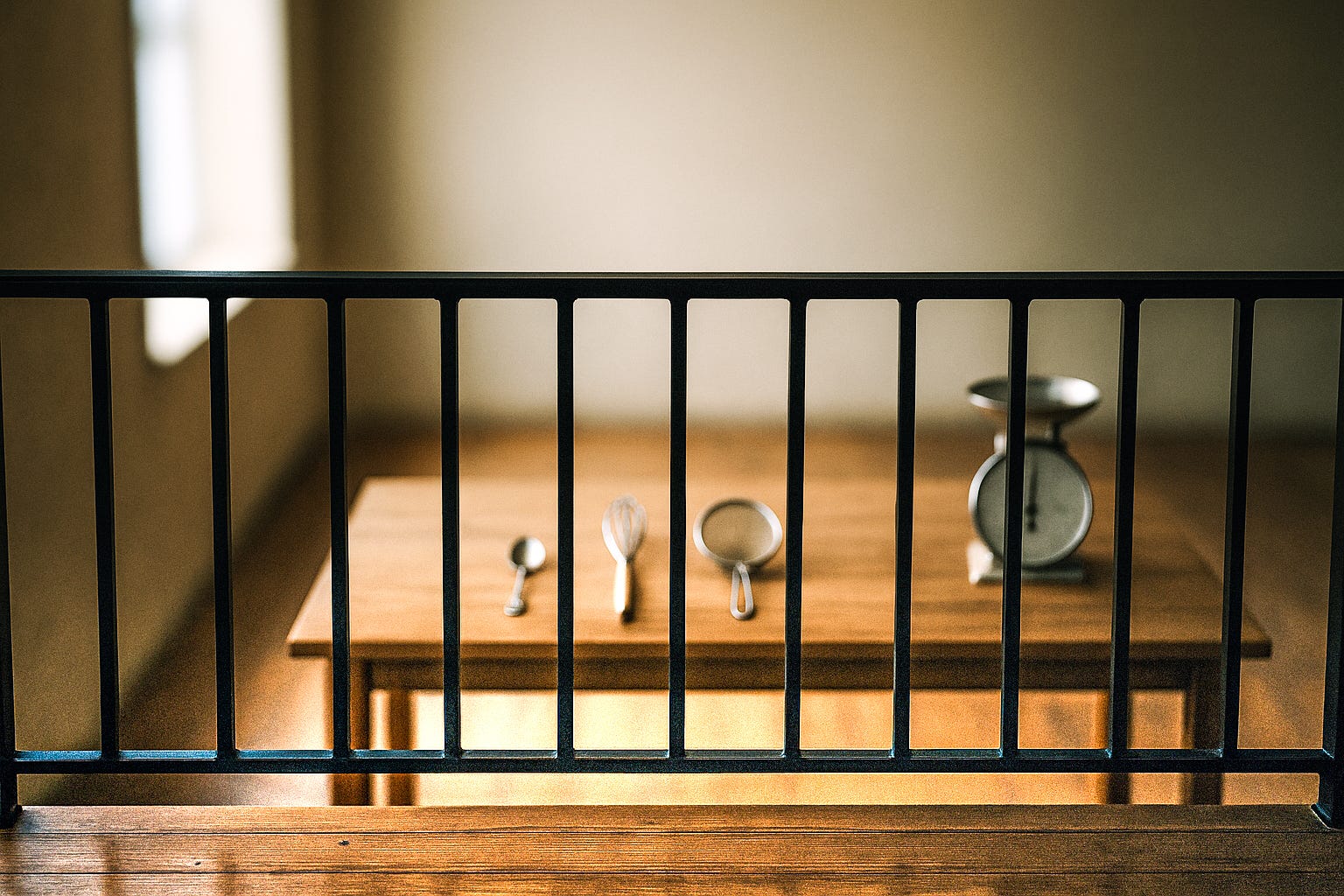
1. Before Any Utensil, There Was Taste
The four Kitchen pieces map the internal mechanics of a universe already in motion:
The Teaspoon — tiny awareness sampling a vast reality
The Whisk — turbulence forming pattern inside boundaries
The Sieve — the three-layered structure that filters chaos into coherence
The Scale — the tragic human belief that measurement equals truth
Together they describe how reality behaves once the cooking has already begun.
But none of them answers the earlier question:
Why is there a Kitchen at all?
Why coherence instead of oblivion?
Why pattern instead of nonsense?
Why taste rather than nothing to taste?
To answer that, we have to step outside the Kitchen entirely.
We have to talk about the taste that existed before ingredients, before utensils, even before the recipe.
2. Gödel: The Universe Cannot Explain Itself
Kurt Gödel — the quiet assassin of 20th-century mathematics — showed something devastatingly simple:
No system can justify its own authority from within itself.
If a system claims absolute completeness:
it’s lying,
it’s circular,
or it’s missing something crucial.
This isn’t philosophy.
It’s mathematics.
And the universe is a system.
Which means:
physics cannot explain why physics works
matter cannot explain why matter exists
consciousness cannot explain itself by describing its neurons
and yes, scriptures cannot prove themselves by citing themselves
The Kitchen cannot explain the Chef.
Gödel forces us to ask:
What lies outside the system?
Whatever it is, it cannot be part of spacetime, energy, matter, logic, or the Sieve’s layers — because those are all the contents of the system.
Gödel, in his polite Austrian way, is telling us:
“Look outside the Kitchen, dear.”
3. Penrose: Consciousness Steps Outside the Rules
Roger Penrose — mathematician, physicist, and serial troublemaker — took Gödel seriously.
He argues that consciousness is:
non-computable
non-algorithmic
not produced by classical physics
capable of stepping outside formal systems entirely
When you grasp a truth — not compute, but grasp — you’re doing something no algorithm can do.
Penrose’s conclusion is scandalously simple:
Consciousness can see outside the system because it isn’t fully inside the system.
He doesn’t call it “the Chef’s Hand,”
but the implication is unavoidable.
4. Planck, Schrödinger, and Wigner: Consciousness Comes First
This is where the balcony view becomes interesting.
These are not fringe figures.
They are the architects of modern physics.
Max Planck (founder of quantum theory) said:
“I regard consciousness as fundamental.
I regard matter as derivative from consciousness.”
In other words:
The Kitchen came after the taste.
Erwin Schrödinger (wave mechanics) went further:
“Consciousness is singular; the plural is unknown.”
Countless minds, one underlying taste.
Many tasters, same soup.
Eugene Wigner (quantum pioneer) argued:
“It was not possible to formulate the laws of quantum mechanics
in a fully consistent way without reference to consciousness.”
Translation:
Without a taster, no soup.
5. Bohm’s Implicate Order: The Hidden Layer Beneath Reality
David Bohm — Einstein’s favourite student and arguably the deepest thinker of the lot — proposed that the universe we experience is the explicate order, an unfolding.
Beneath it lies the implicate order —
a deeper, non-local, non-temporal structure that gives rise to the world.
This isn’t mysticism.
This is physics.
And the implicate order sounds suspiciously like a Condition:
unseen
unfathomable
not inside the Kitchen
but shaping everything within it
Bohm’s phrasing is almost culinary:
“The universe is becoming, not being.”
A recipe unfolding from a deeper taste.
6. Wheeler and d’Espagnat: The Universe Needs a “Participator”
John Wheeler — the man who gave us black holes — argued that reality emerges from information and observation:
“It from Bit.”
Matter from mind.
Structure from participation.
Meanwhile Bernard d’Espagnat spoke of a “veiled reality” —
something behind the measurable world that cannot be accessed directly.
Both are saying:
There is an outside to the system.
The inside is not self-sufficient.
The Kitchen needs the Chef’s Hand.
7. Religion and the Temptation of the Cosmic Shortcut
It’s at this point that religious readers smile triumphantly and say:
“Aha! God!”
But that leap is too fast, too flattering, and too convenient.
The Bible is a product of the human mind —
a Kitchen Scale wrapped in theology.
It tells people how to behave.
It tells tribes how to survive.
It writes cosmic authority into human language.
But it’s still a scale.
Still inside the system.
Still bound by Gödel’s limits.
If there is a Chef’s Hand,
it does not write books through fishermen.
It conditions the entire Kitchen.
And it communicates through:
coherence
symmetry
turbulence
emergence
meaning
experience
…not parchment.
Religion sensed the Condition, but misidentified it as a Person.
This view avoids this trap:
The Chef has taste, not personality.
8. So What Is the Chef’s Hand?
It’s not a field.
Not energy.
Not mind in the personal sense.
Not a deity.
Not an intelligence.
Not a layer of physics.
It is:
**The Condition that allows any universe to exist —
the pre-physical taste in which the cosmos takes shape.**
It does not act.
It does not choose.
It does not interfere.
It simply allows.
It is the ground from which the Sieve filters,
the Whisk stirs,
the Teaspoon samples,
the Scale mismeasures,
and consciousness recognises.
This is the “taste” of my intuition kept steering toward.
Not a flavour within the soup.
The taste that shapes the soup’s possibility.
9. The Balcony View: What the Kitchen Was Really Pointing To
From the balcony, the whole picture becomes clear:
The Teaspoon showed that awareness is local.
The Whisk showed that meaning is turbulent.
The Sieve showed that coherence is layered.
The Scale showed that measurement is hopeless.
But all of these tools operate inside something larger.
A Condition.
A taste older than matter.
A coherence deeper than physics.
A perspective beyond measurement.
Call it what you like:
the Ground
the Taste
the Implicate
the Condition
the Chef’s Hand
What matters is not the name,
but the recognition that the universe — this Kitchen —
is not self-contained.
And consciousness is not a by-product of the recipe.
It is the flavour in which the recipe finds meaning.
10. Closing: The Taste That Came First
The Cosmic Kitchen Series wasn’t wrong.
It simply wasn’t the beginning.
It described the utensils.
This piece describes the taste.
And somewhere, beyond the boundary of physics and the reach of mathematics,
Gödel smiles, Penrose nods, Bohm stirs,
and the universe hums its quiet reassurance:
Before the Kitchen came the Taste.
Before the Taste came the Condition.
And everything else is just cooking.