

The Door

Most of us have stood in front of a door we weren’t entirely sure we wanted to open.
A medical letter.
A tax envelope.
A message that begins with, “We need to talk.”
The door itself is rarely the problem. It’s ordinary, unremarkable. What unsettles us is the uncertainty of what lies behind it — not danger as such, but the absence of clarity.
Technologies like crypto, artificial intelligence, and quantum computing have come to occupy that same psychological space. They aren’t inherently threatening. They aren’t magical either. They’re simply opaque — and opacity invites projection.
When we can’t see how something works, we fill the gap ourselves. Fear, hope, speculation, certainty arrived at far too quickly — all of it gathers at the threshold. The less visible the mechanism, the louder the interpretation becomes. This isn’t irrational; it’s human. We’re pattern-seeking creatures, and when the pattern is hidden, imagination takes over.
I recognise the feeling personally. I invested early in crypto and exited early too — the equivalent of opening the door just enough to glimpse a flicker of light, then deciding it probably wasn’t worth exploring further. It wasn’t a disaster. It wasn’t a revelation. It was simply a withdrawal of belief before the system had time to develop into something coherent. Years later, I still don’t feel fully convinced — which, statistically speaking, puts me squarely in the majority.
That hesitation isn’t a failure of intelligence. It’s a response to how these subjects are usually presented. Ask five people to explain crypto and you’ll hear five confident, incompatible answers. Some describe a civilisational turning point; others dismiss it as speculative noise. Most people stand somewhere between, aware that something is happening but unconvinced they’re being given a usable explanation.
The problem isn’t that these ideas are beyond comprehension. It’s that they’re routinely wrapped in technical fog and tribal certainty. Explanation is replaced by persuasion; clarity by allegiance. Once emotion enters the discussion, understanding tends to leave quietly.
Crypto has suffered particularly from this dynamic. It’s young, loud, ideologically charged, and embedded in a financial world that was already difficult to navigate before anything new was added. When an existing system is dense with fees, delays, and invisible decisions, introducing an alternative — especially one with unfamiliar language — doesn’t feel liberating. It feels exhausting.
People aren’t resistant to new ideas. They’re resistant to being made to feel ignorant for asking basic questions.
So it’s worth pausing at the door itself. Not to argue for what’s behind it, and not to warn against it either, but to acknowledge the experience of standing there. Hesitation is natural. Uncertainty is rational. Complexity, once stripped of noise, is usually far more manageable than it first appears.
Doors aren’t frightening in themselves.
What unsettles us is what we imagine on the other side — long before we’ve looked closely enough to see what’s actually there.
The Lock
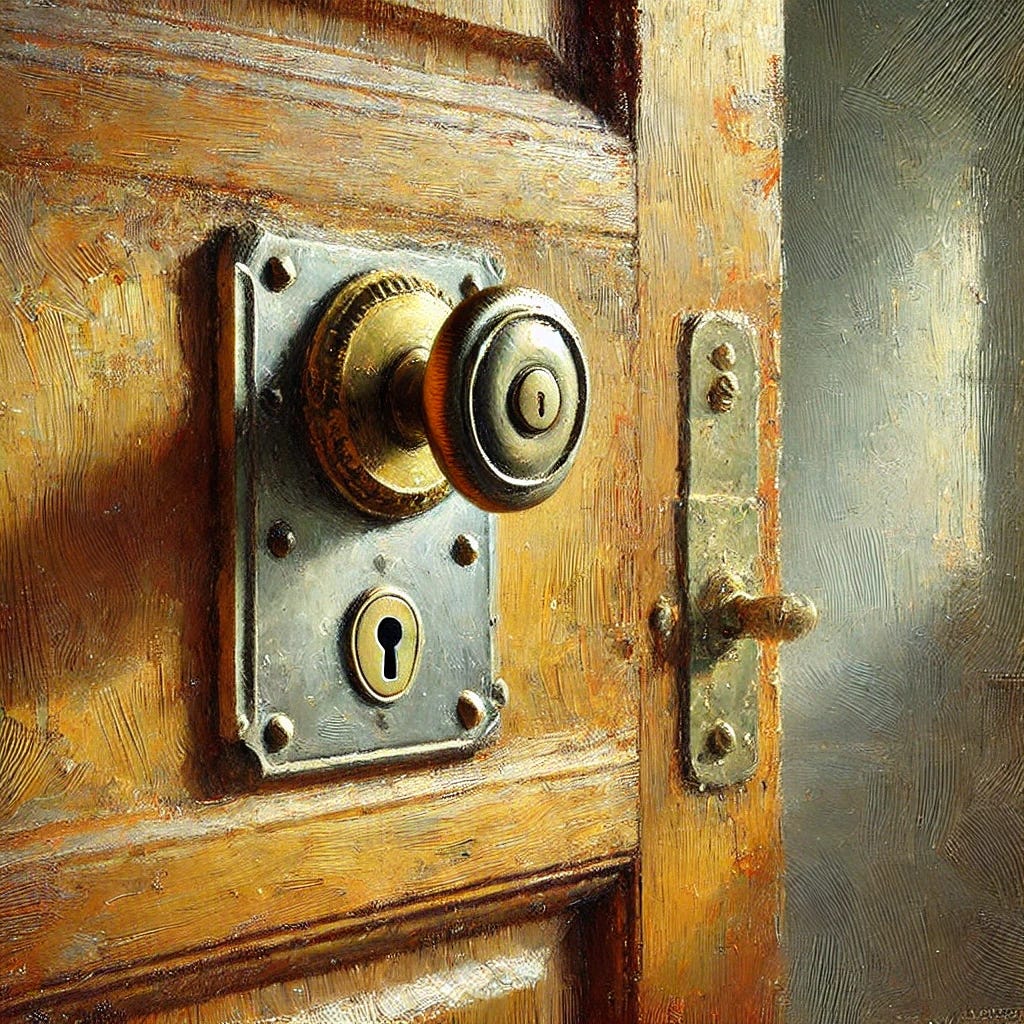
Most of us give very little thought to the lock on our front door. We turn the key, hear the familiar click of metal aligning with metal, and carry on. It’s only when the lock stiffens — or refuses to turn at all — that we suddenly become aware of the mechanism we’ve relied on for years without understanding.
Financial systems work in much the same way.
They sit quietly in the background, solid and unexamined, until the day they fail to behave as expected. Only then do we start asking what machinery lies behind the smooth surface we’ve taken for granted.
Every financial system — traditional or modern — has a lock. A structure that determines who gets access, how securely value is held, and how much friction sits between intention and outcome. Most of the time, we don’t notice it. We’re not meant to. A good lock is designed to be invisible until something jams.
Take traditional finance. On the surface, it appears straightforward enough: you pay, you receive; you invest, you hope for a return. But beneath that apparent simplicity sits a surprisingly crowded corridor of intermediaries — banks, clearing houses, brokers, custodians, identity checkers, settlement agents. Each plays a small, specific role. Together, they form a mechanism that turns slowly but predictably, shaped by decades of accumulated necessity.
This isn’t a story of malice or conspiracy. The lock wasn’t built out of greed; it was built out of problem-solving. Fraud prevention. Record-keeping. Slow communications. Risk management. Trust gaps. Human error. You can almost imagine a locksmith returning every decade, adding another spring or pin to deal with whatever complication society had introduced next.
The result is a system that mostly works — but with quirks.
There are delays.
There are fees.
There are permissions that feel oddly selective.
There is friction in places where, logically, none should exist.
When people say the financial system is “too complicated,” what they usually mean is simpler than that:
I don’t understand the lock, but I’m expected to trust it anyway.
And trust becomes fragile when the mechanism is both essential and opaque.
Consider a basic bank transfer. It feels direct — money moving from one person to another. In reality, it zigzags through layers of checks, batching windows, internal ledgers, external ledgers, reconciliation processes, and settlement cycles. Distance barely matters. Whether the recipient is across the street or across the world, the lock turns at the speed of its oldest component.
Or consider buying a share. The moment you press “buy,” everything feels instantaneous. But ownership doesn’t transfer instantly. Custodians update records. Clearers confirm positions. Regulators log activity. Systems reconcile. What feels fast is the interface, not the machinery underneath it.
We experience the illusion of immediacy.
The lock itself moves slowly.
This is where a subtle misunderstanding sets in. Complexity is often mistaken for intelligence. Friction for protection. Fees for value. In reality, much of this complexity is historical — an artefact of how the system evolved, not proof of its optimal design.
But because the lock sits between us and something we care about — our savings, our homes, our future — we tolerate its peculiarities. We accept the extra turns of the key. We assume the grinding is normal. We stop asking whether the mechanism could have been designed differently.
For a long time, that acceptance held.
Until alternative systems began appearing outside the house altogether — not as improvements to the existing lock, but as different designs entirely. Systems built deliberately rather than accumulated gradually. Systems that didn’t inherit the assumptions of their predecessors because they didn’t need to.
Whether those new designs are better or worse isn’t the point here. What matters is what they reveal: the lock we’ve lived with all our lives is not the only way access can be organised.
And once you see that, it’s difficult to unsee it.
Understanding the lock doesn’t dismantle the system. It doesn’t even criticise it. But it changes how you approach the door — and prepares you to recognise what a key actually does when it finally appears.
The Key

A key is a deceptively simple object. A small piece of metal, a handful of ridges cut with modest precision — and suddenly a lock that resisted moments earlier turns with almost embarrassing ease. Nothing about the door has changed. The lock hasn’t been dismantled. One small element of the system is simply interacting with it differently.
New technologies tend to arrive like that.
They don’t remove doors.
They don’t tear out existing mechanisms.
They reveal that access can be organised on different principles.
For decades, we’ve lived inside financial systems shaped by habit, history, and administrative necessity. As we saw with the lock, complexity accumulated not because anyone planned it, but because that’s how systems evolve: they grow around their own limitations. Over time, they harden. They become familiar. Eventually, they feel inevitable.
Every so often, though, something appears that doesn’t fit the inherited pattern. Not an upgrade to the lock, and not a rebellion against the door — just a key cut to a different logic. And once you see a lock respond to a key shaped by transparency rather than opacity, automation rather than administration, the system no longer feels like the only possible design.
This is where cryptocurrencies enter the picture.
Not as a revolution, and certainly not as a replacement for the world we inhabit. They function instead as a new kind of key — one shaped by mathematics rather than bureaucracy, by consensus rather than intermediaries, by rules that cannot quietly shift once the door is closed. They don’t promise perfection. They don’t eliminate risk. But they demonstrate something important: that trust can be structured differently.
You don’t have to believe in them to recognise the implication.
When a lock responds cleanly to a key designed without its inherited quirks, the tumblers align. The mechanism behaves differently. A pathway opens — not because the old system failed, but because the new one illuminated an alternative that was previously hard to imagine.
Much of this alternative rests on blockchain: a shared ledger that secures records collectively rather than delegating oversight to a single authority. It doesn’t make traditional finance obsolete. The old lock still turns, even if stiffly. It still protects value, even if with more friction than we might like. Nothing is broken. Nothing is collapsing.
But now, beside the old brass key hanging on the wall, there is another — cut differently, designed around a different philosophy of trust, capable of opening certain systems without the layers of mediation we once assumed were permanent.
Some people will never use it.
Some already do.
Most will wait.
What matters is not which key is chosen, but that the mechanism is finally understood. We’re no longer turning the lock blindly. We’ve seen the structure. We recognise the design choices. We understand that alternatives exist.
And once you know that a system can be opened in more than one way, the door stops feeling imposing. The room behind it becomes less mysterious. You approach it differently — not with fear, not with blind trust, but with awareness.