

Introduction
(Part IV of the Cosmic Kitchen Series)
There comes a point in any exploration — physics, philosophy, baking, or simply being alive — when you realise you’ve spent a great deal of time describing the tools without ever stepping back to look at the kitchen they belong to.
The Cosmic Kitchen Series started with three humble utensils: the Teaspoon, the Whisk, and the Sieve.
Each captured something about the way consciousness and the universe behave — metaphors that made sense to me long before I could explain why.
But now feels like the moment to bring them all onto the same worktop and see what they reveal together. Because consciousness isn’t merely a teaspoon dipped into experience; it’s a teaspoon inside a cosmic mixture being whisked into turbulence and sifted into coherence long before we show up to notice anything.
These metaphors aren’t science. They’re simply the clearest way I can picture how reality feels.
Which brings us to the awkward bit: human measurement.
Our beloved habit of confusing “what we can measure” with “what is real.”
And that’s where the Kitchen Scale walks in — earnest, literal, and blissfully unaware of its own limitations. The perfect emblem of the human mistake: weighing the world with something that only measures the parts small enough to fit on the pan.
Before we get to the moral of the story, let’s set the scene.
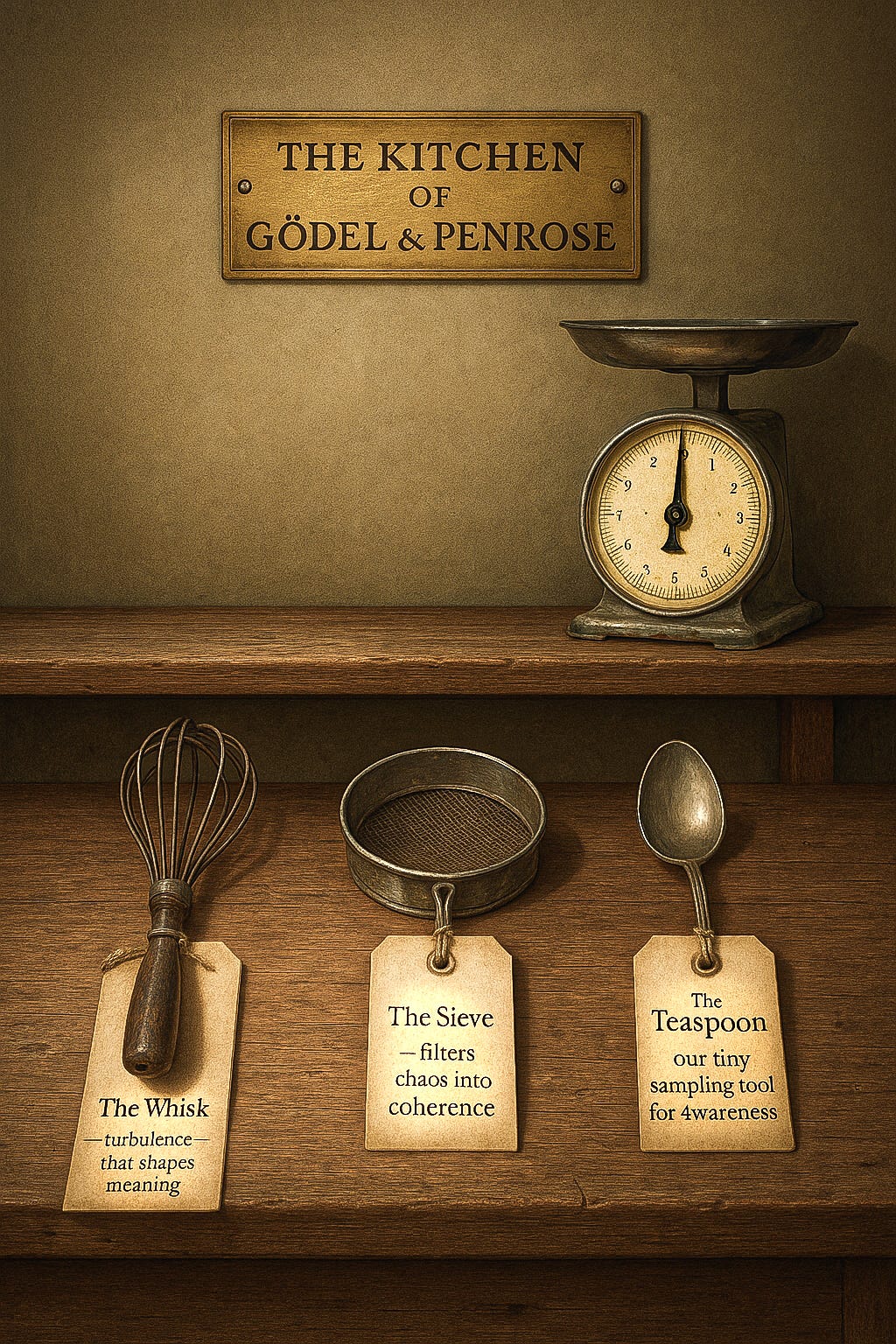
From the Kitchen of Gödel & Penrose
— where turbulence becomes meaning, chaos becomes coherence, and reality remains stubbornly unmeasurable
The Tools on the Worktop
On a wooden worktop lie three simple kitchen utensils, neatly arranged like the instruments of a craftsman:
The Whisk — turbulence that shapes meaning
The Sieve — filters chaos into coherence
The Teaspoon — our tiny sampling tool for awareness
These aren’t objects so much as cosmic behaviours:
chaos being stirred into pattern
pattern being sifted into structure
structure being tasted by human awareness in the smallest possible scoop
This is the machinery of the universe long before measurement enters the room.
And below the worktop — a little sheepishly — sits the Kitchen Scale.
A solid, old-fashioned mechanical thing.
Sturdy. Honest. Confident in all the wrong ways.
The perfect symbol for our human belief that reality is whatever the scale says it is.
Gödel Walks Into the Kitchen
Penrose tells a story about sitting in a mathematical logic class in Cambridge and learning Gödel’s incompleteness theorems properly for the first time. It hit him like a thunderclap — and it’s easy to see why.
Gödel proved that any formal system powerful enough to do arithmetic will always contain truths it cannot prove — even though those truths are, in fact, true.
A mathematical Kitchen Scale, if you like.
Even worse:
No system can prove its own consistency from within itself.
If it tries, it collapses into contradiction or circularity.
So the system — the scale — is always limited.
It cannot see everything that is true.
It cannot certify its own reliability.
It cannot step outside itself.
But we can.
The Missing Gödel Expansion
Gödel didn’t just show that systems have unprovable truths.
He showed something stranger, almost impolite:
A system cannot fully describe itself.
Not in mathematics.
Not in physics.
Not in consciousness.
Not anywhere.
A Kitchen Scale can weigh everything except the hand holding it.
This was the subtle piece missing:
Gödel exposed a kind of built-in blindness in all closed systems.
If a system tries to explain itself from within, it:
loops
contradicts itself
or leaves something vital out
It has to. That’s the cost of being a system.
This means:
physics can’t explain why physics works
logic can’t explain why logic makes sense
neurones can’t explain why awareness feels like anything
measurement can’t measure the measurer
Gödel’s incompleteness isn’t a glitch.
It’s the universe whispering:
“You’re more than your instruments.”
Penrose and the Leap Outside the System
This is the point Penrose clings to.
Human understanding can see the truth of a Gödel sentence from outside the formal system.
And that “seeing”:
is not computable
is not rule-bound
is not algorithmic
is not measurable
This is Penrose’s controversial leap:
consciousness isn’t acting like a formal system at all.
It behaves more like a non-computable insight engine — something that grasps truth directly, not through calculation.
Just as our experience grasps realities the Kitchen Scale cannot weigh, or the Sieve cannot separate.
Gödel, the mathematician, quietly supports the Teaspoon, the Whisk, and the Sieve.
Penrose, the physicist, looks at Gödel and concludes:
something about consciousness isn’t captured by the rules.
Measurement, Mis-measurement, and the Human Blind Spot
We humans adore certainty.
We adore numbers.
We adore the scale because it gives us a sense of control:
200 grams of flour
3 teaspoons of sugar
Proof. Precision. Certainty.
But certainty is a comfort, not a truth.
Awareness doesn’t weigh in grams.
Meaning doesn’t appear on a dial.
Yet we trust the scale more than we trust the thing doing the weighing — ourselves.
That’s the absurdity Gödel points to, Penrose worries over, and the Cosmic Kitchen illustrates:
We built a measurement system
that cannot measure the one thing
we’re absolutely certain is real —
our own awareness.
Summary
The Kitchen Scale isn’t wrong.
It’s just inadequate.
And the trouble starts only when we mistake adequacy for authority.
The Whisk, the Sieve, and the Teaspoon aren’t tools we invented.
They’re behaviours baked into reality long before human beings appeared:
turbulence forming meaning
filtration forming structure
awareness sampling experience
Measurement comes afterwards — the latecomer at the party.
Gödel’s great gift was to show us that no system can contain the whole of itself.
The Kitchen Scale weighs ingredients, not experience.
Formal logic proves theorems, not meaning.
Physics predicts motion, not awareness.
The one thing capable of stepping outside the system
is the thing doing the stepping:
Reality isn’t what fits onto the scale.
Reality is what notices the scale is even there.