

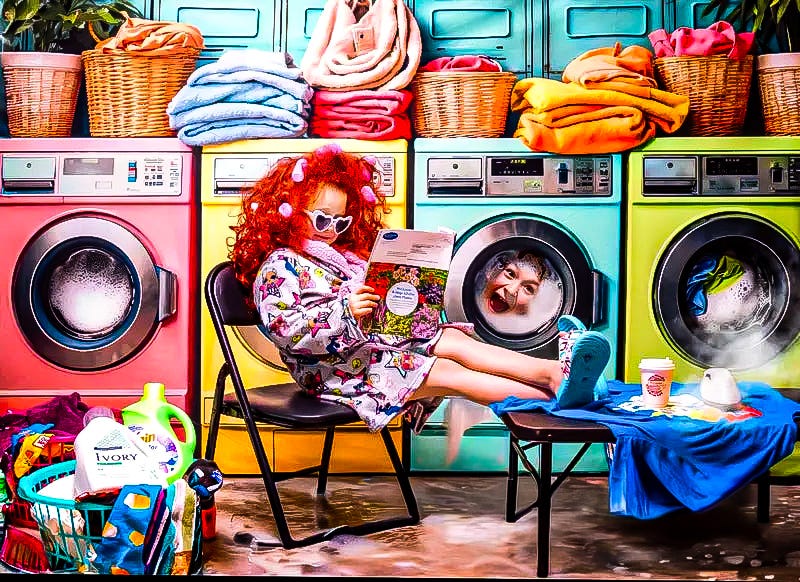
There comes a moment in every household when good intentions die.
A moment when you stop sorting whites from colours, delicates from towels, wool from synthetics — and simply shove everything into the machine and hope for the best.
That moment is called social media.
Because if Part 1 was the illusion of immaculate order, and Part 2 was the first gentle bleed of colour, then Part 3 is where the basket tips over and the whole lot lands on the floor in a glorious, tangled heap.
Welcome to the mixed wash.
The Day We Stopped Sorting
Social media didn’t “arrive” the way newspapers once did — folded, punctual, and delivered with a thump at the front door.
It seeped in.
It oozed.
It proliferated.
First it was a place for university students.
Then for friends.
Then for families.
Then for brands, politicians, conspiracy theorists, Russian troll farms, disillusioned poets, failed comedians, agitated retirees, teenagers with ring lights, and absolutely everyone in between.
The old media world relied on filters.
The early internet relied on friction.
Social media relies on none of that.
It’s the first communication system in human history where everyone is publishing, all the time, to everyone else.
You can’t sort that kind of basket.
The Algorithm Becomes the Editor
In the old white-shirt era, an editor decided what mattered.
In the early web era, effort decided what mattered.
In the social media era?
A machine decides.
A machine that doesn’t care about:
• truth
• nuance
• context
• proportion
• public interest
• national sanity
• or whether your aunt should really be reading that at 2am
It cares about one thing:
engagement.
It’s the washing machine equivalent of turning the dial to “Turbo” and walking away.
You don’t control what goes in.
You don’t decide how it spins.
And you’re not prepared for what comes out.
The whites go grey.
The colours fade.
The delicates die.
And somehow that wool jumper emerges two sizes too small but angry enough to file a complaint.
A Thousand Front Pages
Newspapers once created one front page for millions of people.
Social media creates a million front pages for one.
Your feed isn’t “the news.”
It’s a personalised hallucination, updated by the minute, optimised for maximum stickiness.
Two neighbours can live five metres apart, share a broadband router, and still inhabit completely different realities.
It’s not a public square.
It’s a million private echo chambers stitched together with duct tape and outrage.
And the great irony?
We mistake this fragmentation for freedom — when it’s actually the collapse of coherence.
Nobody knows what’s going on because everybody’s seeing something different.
The Collapse of the Middle
Industrial society relied on “the middle”:
• middle-class stability
• middle-ground politics
• middle-of-the-road culture
• middle-brow media
• middle-management decision-making
Social media destroyed the middle.
It rewards extremes.
It amplifies outrage.
It prioritises noise over signal.
The result?
Everything gets thrown in the same wash:
• serious journalism
• cat videos
• political propaganda
• personal grief
• corporate advertising
• celebrity meltdowns
• pseudo-wisdom
• genuine insight
• lies
• truth
• and a man in Ohio reviewing different types of mayonnaise for some reason
All of it mashed together with no hierarchy, no sequence, no beginning, and no end.
The mixed wash, in full spin.
Unfiltered Democracy (For Better and Worse)
Social media is the purest form of democratic communication ever invented.
It’s also the purest form of undemocratic manipulation ever invented.
The paradox isn’t accidental — it’s inevitable.
Give everyone a voice, and you get freedom.
Give everyone a platform, and you get noise.
Give everyone an audience, and you get collapse of proportion.
It isn’t that social media broke society.
It’s that it showed us what society actually looks like when you remove friction, effort, expertise, and structure.
Multicoloured.
Chaotic.
Loud.
Human.
Impossible to fold neatly again.
Reflection
The mixed wash of social media didn’t arrive as a moral failure or a technological accident. It arrived because humans — when freed from the filters and bottlenecks of old media — do exactly what they’ve always done: mix everything together and hope the end result somehow makes sense.
It doesn’t.
Not immediately.
Not cleanly.
But it reveals something essential: the basket is no longer being sorted by moguls, editors, or scarcity. It’s being sorted by us — which means it isn’t being sorted at all.
Social media didn’t kill coherence.
It simply removed the people who used to pretend coherence existed.
Part 3 of the Laundry Series.