

Introduction
I should probably explain why I in late 1985 turned up at the “Chicken Farm” in the first place.
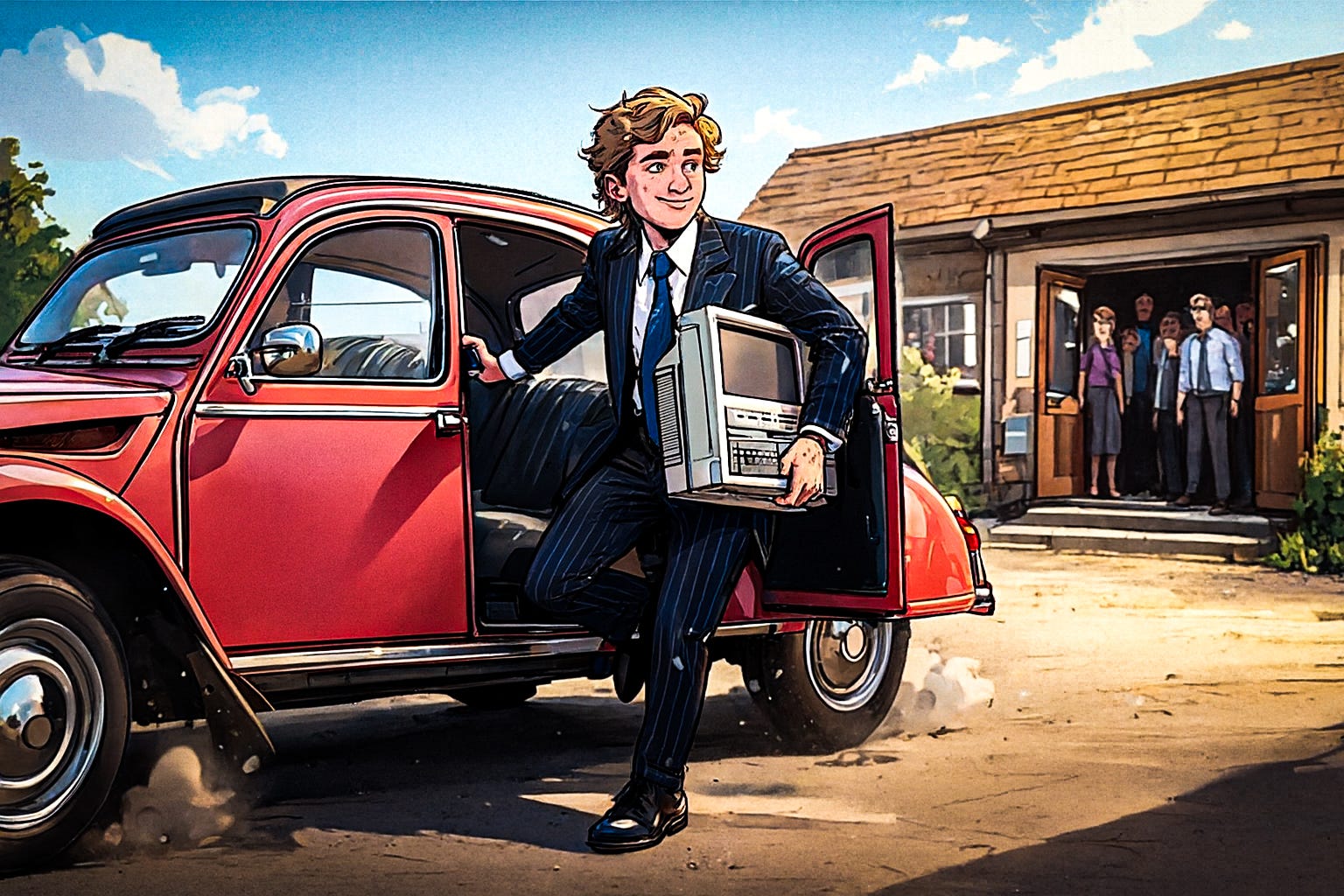
Three months earlier, I’d finished my university studies in international business and statistics and, like any self-respecting twenty-something with more ambition than sense, decided I was ready for the world. Nothing, in my mind, could stop me. I invested everything I had — and I mean everything — in presentation, a Ralph Lauren pinstripe suit, black brogues polished to a glare, and two shirts from Hilditch & Key. This, I believed, was how one prepared for greatness.
What I was actually preparing for was Fontwell.
The company I’d joined produced remarkably good B2B intelligence products for the global healthcare industry — exactly the sort of work I wanted to throw myself into. Unfortunately, its previous owner had taken a rather creative approach to accounting and was now behind bars. The business was about to be shut down. Enter me: one optimistic young economist.
That’s how I found myself heading south from London toward a failing office I would later, with a mixture of affection and disbelief, nickname the “Chicken Farm” — convinced I was about to make a magnificent entrance.
(Reader: I did. Just not in the way I imagined.
1. The Chicken Farm
By the time I stepped into the Fontwell office for the first time, the staff had endured enough chaos to recognise trouble on sight.
I was wearing a pin-striped, double-breasted Ralph Lauren suit, a light-blue cutaway shirt, a silk tie in a defiant double Windsor, and black brogues polished like obsidian.
When I came through the door, every head lifted from an electric typewriter. Twelve staff members stared as if an alien had landed. Which, in a sense, one had. The previous owner was behind bars for creative accounting, morale was subterranean, and now a twenty-six-year-old economist from a London university had arrived in pinstripes, waving the flag of the future.
The mood did not improve. But I unpacked the IBM, set it on the desk like a relic from a superior civilisation, and began explaining spreadsheets. You could feel the air tighten — a mix of curiosity and fear, the first of many pin-drop moments in my career.
Looking back, the only thing that stopped them fitting me for a straitjacket was that I still had the company chequebook.
2. The Fax Affair
By 1986-87, the IBM was humming away like an obedient dog, the staff had stopped flinching when I entered the room, and I was beginning to believe we’d dragged the company into the modern world. Then the fax machine arrived.
To me it was a revelation — the world’s first instantaneous bridge between words and paper. To everyone else, it was a sacred device, to be used only for solemn correspondence, preferably accompanied by a covering letter typed in triplicate.
Naturally, I thought: why not use it for sales?
The logic was flawless. We operated internationally, the telex was dying, and our new fax could send short, elegant notes to potential clients anywhere in Europe. So I composed a few brisk, well-mannered introductions: “We’ll be calling shortly to present our services…” Two or three lines at most.
What I’d overlooked was that in those days fax machines ran on thermal paper sold in rolls, and every incoming page literally cost the recipient. My elegant little introductions weren’t just uninvited — they were using up their office supplies. It was, as one particularly British correspondent put it, “simply not cricket.”
I sent them out with the excitement of a child launching paper aeroplanes.
They came back like boomerangs.
Unfortunately, they weren’t enquiries. They were formal complaints.
Apparently, using a fax machine for sales messages was an act of commercial indecency. “This is not what these machines are for,” one indignant German wrote, as though I’d used the national flag as a napkin. Another demanded I “cease immediately.”
I’d stumbled into a new kind of heresy — forward thinking without permission.
Today, entire industries make a fortune doing precisely the same thing by email and call it outreach. But in 1986, I was the only heretic in the village. My innovation had once again arrived early, and, in keeping with tradition, uninvited.
3. The Unix Interlude
By the late ’80s we had escaped the so-called Chicken Farm and moved into new offices in central Chichester — a sparkling space that, to the staff, felt like Manhattan with cathedral views. To me it was symbolic: the provincial cocoon had been shed; we were finally stepping into the modern age.
Every desk now boasted a personal computer. I’d insisted on it — the electric typewriters had been retired, ceremonially replaced with humming IBMs and early Compaq’s. Or so I thought.
A few months later, during an inventory check, I discovered that several of the “retired” machines had mysteriously migrated beneath desks, camouflaged under tottering piles of paperwork — exactly the clutter I’d been trying to eliminate. It was like finding contraband in a monastery. When confronted, the culprits explained, perfectly reasonably, that the typewriters were “for emergencies.”
That set the tone for my next bright idea: Unix.
To me, it was magnificent — austere, precise, capable of orchestrating the entire publishing process in a single logical flow. To everyone else, it was an alien language designed to make simple tasks unnecessarily terrifying.
The idea was that researchers and analysts would input their data directly, the system would format everything automatically, and we’d finally have a clean, digital workflow.
Technically, it worked. Socially, it detonated.
I’d present a demonstration — “You see, it prints the reports for you!” — and the room would fall into that familiar, unnerving silence, the one that suggests people are searching for an exit rather than enlightenment. They didn’t say “We can’t”; they said “We’re not sure it’s necessary.” Which, translated from corporate dialect, means “Over our dead bodies.”
So the Unix system sat in the corner, humming nobly, largely ignored — a Ferrari idling in a barn full of bicycles. Years later, when those same people proudly adopted “digital workflows,” I smiled benignly. The grin, as always, was frustration disguised as patience — my most finely tuned survival skill.
4. The Filofax Wars
By the early ’90s, we were a picture of modernity — or so I thought. PCs whirred dutifully, printers hummed, and the word database had finally entered the office vocabulary without causing panic. I’d begun to feel almost mainstream. That illusion lasted until I bought my first Psion electronic organiser.
To me, it was liberation in pocket form — a machine that could store schedules, notes, even send email if coaxed correctly. To everyone else, it looked like a calculator that had gone to finishing school.
At the time, the Filofax was still the height of professional chic. Executives carried them like medals of importance — thick leather covers bulging with handwritten appointments and business cards of people they could no longer remember. A man’s Filofax, it was said, was his portable self-worth.
So when I walked into meetings tapping away on a grey plastic Psion instead of ceremonially opening a binder of paper, the effect was seismic. The looks I received were somewhere between pity and fear. I may as well have been taking notes on a toaster.
“Can it really send messages?” one colleague asked, half fascinated, half appalled.
“Yes,” I said, “though no one else can receive them yet.”
It was meant as a joke — my Alexander Graham Bell moment — but no one laughed. They thought I was serious, which in a way made it funnier. Every pioneer of communication starts by talking to himself.
I could sense a growing apprehension whenever I entered a room too energetically. They had learned that every time I smiled, another process was about to change.
I wasn’t showing off; I was simply thrilled by the efficiency, by the idea of collapsing the office into something portable and personal. What I hadn’t realised was that for most people, the Filofax was personal — a comforting physical record of their competence. My sleek little organiser wasn’t just technology; it was heresy.
Looking back, I can’t blame them. Their leather-bound calendars didn’t beep, crash, or require spare batteries. They were also, mercifully, not connected to the internet — a quiet luxury we didn’t recognise at the time.
Today, of course, the world has swung violently the other way. Everyone now multitasks through glowing screens while walking, driving, or cycling — the very plague I’d once predicted. The Filofax may have been bulky, but at least it didn’t kill anyone at traffic lights.
5. The Bridge
Sometimes I think the Navy prepared me perfectly for business — just not in the way anyone intended. I’d been trained as a minesweeper commander: to read the invisible, to act before the explosion, to keep calm when no one else quite understood what was happening.
Running that company felt much the same. The office was my bridge, the staff my crew, and the new technologies — fax, Unix, Psion — were mines waiting to detonate at the slightest mishandling. My job was to steer us through without losing too many along the way.
It amused me endlessly how often the two worlds overlapped. In the Navy, when an order was misunderstood, someone might sink. In business, the stakes were lower — but the expressions were eerily similar. The same combination of fear, defiance, and silent prayer.
There were days I’d walk through the office, scanning terminals instead of radar screens, feeling that same mixture of pride and frustration. Pride because the ship was afloat. Frustration because the crew, however capable, didn’t share the map in my head.
And like any commander, I learned restraint — to smile when I wanted to shout, to disguise urgency as calm, to let the crew believe the ship was steady even when the instruments said otherwise. It’s a peculiar kind of leadership: equal parts strategy, persuasion, and quiet despair.
But the mission never changed — keep the vessel moving, anticipate the next wave, and trust that, eventually, the rest of the fleet would catch up.
6. The Crew Adapts
After the Psion came a succession of other “forward-thinking incidents,” each with its own blend of confusion, resistance, and eventual surrender. By that point, however, the crew — sorry, employees — had become battle-hardened.
They’d learned that whenever I appeared in the doorway looking suspiciously cheerful, something futuristic was about to descend upon them. The early reflex of fear gave way to a kind of professional fatalism. They didn’t bother asking what it was anymore; they simply asked how long it would take to stabilise.
In truth, it became a ritual. A few of them admitted years later that if a month passed without my unveiling some new machine, system, or grand plan, they’d start to worry. One even said, “If Eric’s not reinventing something, he’s either unwell or has stopped caring about us.”
That comment, oddly enough, touched me. They’d come to understand that my restlessness wasn’t vanity or obsession — it was, in its own eccentric way, a form of care. I wanted the ship to sail faster, cleaner, smarter. They wanted the waves to stop for lunch.
By then, we’d reached an understanding: I would innovate in manageable doses, and they would pretend to be surprised.
7. The Substack Paradox
These days, the bridge looks different. The radar has been replaced by a screen full of icons, and the seas are digital, not physical. But the feeling — that peculiar mix of anticipation and doubt — hasn’t changed at all.
I find myself once again at the edge of something new: a blank Substack page glowing on my monitor, waiting to be filled. It’s not code this time, or cables, or laser printers humming into the night. It’s words. My words.
And still, the old hesitation stirs. I can hear the echoes of those boardrooms and back offices: the pin-drop silences, the wary glances, the “is this really necessary?” mutterings. Perhaps they’re still right to ask. After all, I’ve spent most of my life being early — sometimes spectacularly so.
There’s a temptation to rush in, to treat this like another mission: raise the flag, sound the klaxon, full steam ahead. But I’ve learned — painfully, repeatedly — that being first is no guarantee of being understood. The trick now is to launch not from impatience, but from purpose.
Substack feels oddly familiar. It’s a vessel built for exploration — a way to chart ideas and invite others aboard, if they dare. But unlike those earlier voyages, there’s no crew to cajole or technology to debug. Just the open sea of readers, and me at the helm again, wondering if the world’s finally caught up.
I sometimes laugh at the thought: the former minesweeper commander still navigating invisible currents, still trying to bring coherence to chaos, still wearing that grin of frustration disguised as patience. Only now, the explosions are metaphorical, and the mines are ideas waiting to detonate in someone else’s mind.
And if, once again, I’ve launched too soon — well, I’ve had practice.
After all, the mission was never just to arrive. It was to see ahead, to sound the depths, and to leave a map for those still coming up astern.