

Introduction
(Part III of the Cosmic Kitchen Series)
Why Reality Doesn’t Collapse Into Nonsense — And What It Means for Minds (and AI) isn’t just a headline.
It’s the question quietly lurking underneath every modern debate in physics, neuroscience, and now artificial intelligence:
How does the universe stop itself from becoming nonsense?
And why does that single fact shape every form of mind the universe can produce — biological or artificial?
By the time you arrive at The Sieve of Coherence, you’ve tasted the cosmic broth and watched it swirl.
Now we reach the part no physicist phrases plainly enough — the part hidden beneath the equations, the jargon, and the priesthood that interprets them.
Because for all its mathematical splendour, reality behaves far more intuitively than the language wrapped around it.
And if we’re going to speak honestly about minds — human or artificial — we must first understand the one thing that makes any mind possible in the first place:
The universe’s ability to filter chaos into coherence.
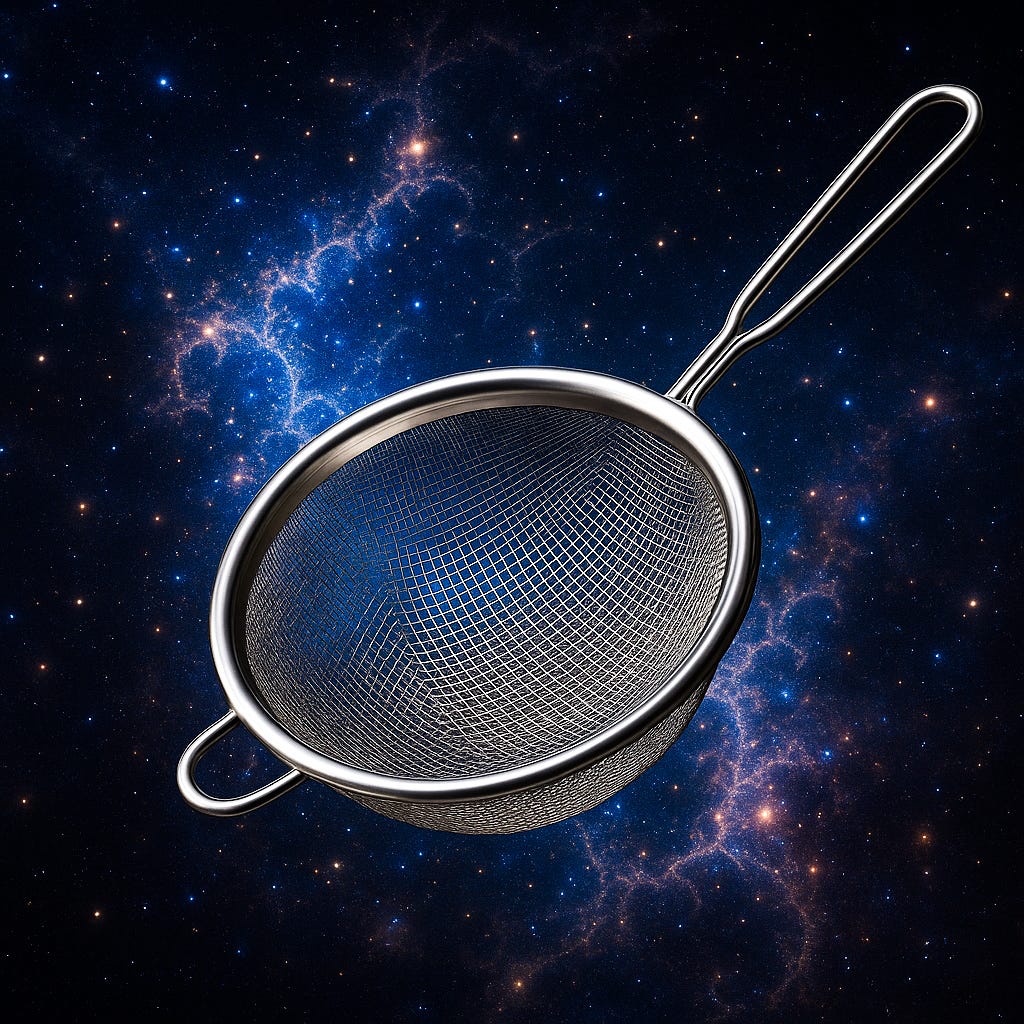
Part III is where the Cosmic Kitchen stops being a metaphor and becomes a framework —
a way to see reality not as a pile of stuff, but as a hierarchy of coherence-making processes.
Flour → sift → bowl.
Chaos → pattern → form → awareness.
People avoid talking about the structure of the universe not because the ideas are beyond them,
but because the language has drifted into a kind of monastic dialect.
Modern physics, brilliant as it is, often reads like the Latin of Science:
a specialised vocabulary that impresses insiders and repels everyone else.
Strip that away, and something simple remains:
The universe doesn’t build structure — it filters it.
A cosmic sieve, turning raw entropical chaos into something workable enough for experience to exist.
And that’s where we begin.
1. The Quantum Foundation
The Raw Grain — Unsorted, Unstable, Completely Entropical
At the bottom of the sieve sits quantum reality:
the domain of flicker, jitter, uncertainty, and probability.
Here everything is:
granular
restless
half-formed
unpredictable
entropical in the deepest sense
Particles don’t behave —
they misbehave beautifully.
They appear, vanish, interfere, overlap, contradict themselves,
and generally treat the laws of common sense with open contempt.
It’s like pouring flour straight from the bag:
it clumps
it floats
it sticks to your shirt
it refuses to go where you want it
The quantum layer is pure potential —
the seedbed of reality before structure has a chance to show up.
But potential alone can’t build a universe.
It needs a filter.
2. The String Fabric
The Middle Mesh — Where Probability Becomes Pattern
This second layer is the fine metal mesh of the cosmic sieve —
the level that turns restless quantum chaos
into something coherent, continuous, and meaningful.
Call it strings.
Call it fields.
Call it resonant geometry or harmonic structure.
The names vary, but the function does not:
it filters randomness
it introduces rhythm
it establishes coherence
it turns jitter into vibration
it shapes possibility into pattern
This layer is where chaos begins to make sense.
It is the universe’s first act of refinement.
The string fabric doesn’t eliminate chaos —
it organises it.
This is entropical order:
turbulence bound by resonance.
The cosmic sieve turns the raw quantum flour
into the first smooth blend of structure.
From here, reality has something to work with.
3. The Relativistic Continuum
The Coarse Sieve — The Geometry of Form and Experience
The uppermost layer is the broadest sieve —
the one that gives us the world we inhabit:
spacetime
gravity
motion
mass
stable shapes
predictable laws
the conditions for life and awareness
This is Einstein’s realm —
the sweeping geometry of existence.
Where the quantum world clumps
and the string world vibrates,
the relativistic layer flows.
Smooth curves.
Consistent trajectories.
A stage on which events can unfold
and minds can evolve.
If quantum reality is the flour
and string reality is the sift,
then the relativistic layer is the bowl —
the container that holds everything steady enough
for meaning to appear.
This is the layer where consciousness
finally has space to exist.
Awareness requires:
continuity
predictability
memory
identity
structure
All of which emerge only after the finer sieves have done their work.
THE BIG PICTURE
Reality Isn’t Built From Matter — It’s Built From Filters
Once you see the sieve, it becomes impossible to unsee.
Reality unfolds like this:
Chaos → (fine mesh) → Pattern
Pattern → (coarse mesh) → Form
Form → (container) → Awareness
The universe is not simply a hierarchy of stuff.
It’s a hierarchy of coherence-making processes.
A filtering system.
A cosmic sifter.
A kitchen tool built into the fabric of reality itself.
Chaos doesn’t magically become consciousness.
It becomes coherence.
Then coherence becomes form.
Then form becomes experience.
The universe is, in a sense,
a structure that refines turbulence
into something capable of noticing itself.
Entropical potential
→ entropical pattern
→ entropical mind.
Once you see the universe as a sieve rather than a machine,
you start to see minds — human or artificial —
not as accidents of biology,
but as natural expressions of a coherent cosmos.
End Note
This piece is Part III of the Cosmic Kitchen Series.
If you’d like to follow the thread from the beginning:
Part I — The Teaspoon and the Cosmos
How our tiny human awareness samples the vastness of reality.
Part II — The Whisk in the Universe
Why meaning emerges from turbulence — and how chaos becomes structure.
Together they form the foundation for what you’ve just read:
a way of seeing consciousness, AI, and the universe through the same coherent lens.