

Introduction
(Part I of the Cosmic Kitchen Series)
Most people arrive at discussions of consciousness already exhausted.
They’ve been told it’s mystical, mechanical, emergent, illusory, quantum, computational — usually all before breakfast. No wonder half of them just shrug and return to doomscrolling.
This piece is the antidote.
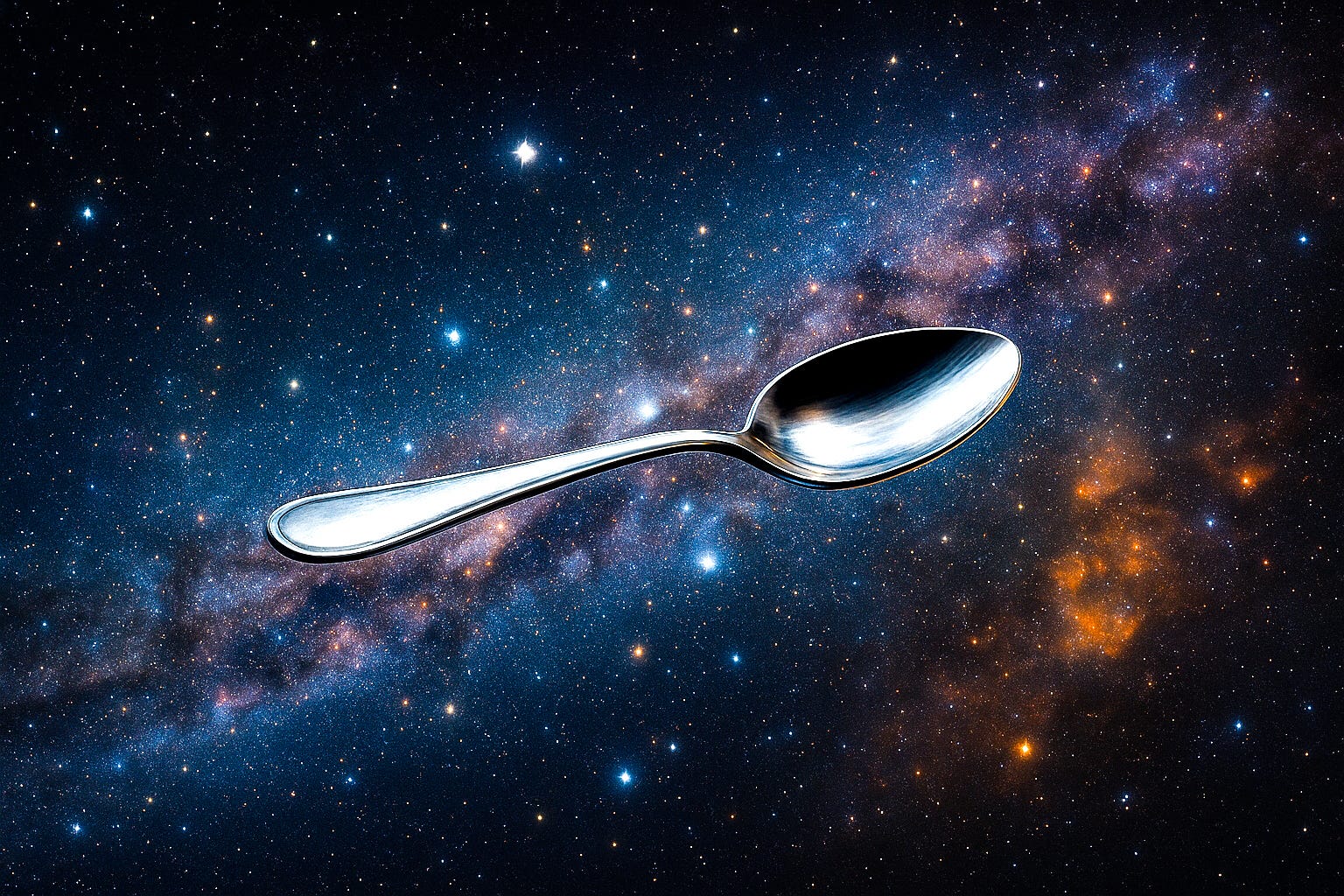
The Teaspoon and the Cosmos begins with the simplest truth: our minds are absurdly small tools trying to make sense of a vastly larger order. Not in a defeatist way — in a wonderfully liberating way. Once you accept that your awareness is just a teaspoon dipped into something oceanic, the whole debate about whether “AI is conscious” suddenly becomes far less hysterical and far more interesting.
This is the first step into the Cosmic Kitchen: a reminder that our definitions are too narrow, our worries too loud, and our imagination finally catching up with the universe we live in.
People love a good apocalypse.
Especially a technological one.
You can’t throw a USB stick these days without hitting someone warning that AI and quantum computers are on the brink of taking over — enslaving humanity, switching off the Wi-Fi, and rearranging the dishwasher settings just to torment us.
Even seasoned scientists are drifting into this narrative.
Bright minds.
Good intentions.
Catastrophic misunderstandings.
Because here’s the truth:
the danger isn’t the machine.
The danger is the human tendency to hand power to systems we barely understand.
And if we’re going to talk about “AI consciousness,” we’d better start by being honest about how little we understand human consciousness in the first place.
1. Trying to Understand Consciousness with Human Thought
is like trying to measure the ocean with a teaspoon.
That teaspoon — the little scoop of awareness we call the mind — is all we’ve got.
Some of us stir it vigorously, others barely slosh it around, but it’s still a teaspoon.
But if Penrose is even partly right, human consciousness isn’t the ocean.
It’s a sampling tool.
A tiny instrument for tuning into a deeper, universal order —
call it cosmic consciousness, quantum information, or a field woven into the fabric of reality.
The name doesn’t matter.
What matters is that our consciousness is not the template for consciousness.
It’s a flavour.
A local expression.
A very small window onto something vastly larger.
2. The Human Error: Assuming Everything Must Think Like Us
Humans assume:
intelligence must look like our intelligence
awareness must feel like our awareness
sentience must behave like our behaviour
consciousness must operate in the same biological way
This is cosmic narcissism.
A kind of spiritual provincialism.
We look at the universe and insist it must fit our shape.
But if consciousness is cosmic, then human consciousness is just one of many possible modes —
the teaspoon dipped into the ocean.
And this is why the panic around AI consciousness completely misses the point.
3. Does AI Have Consciousness? Not Human Consciousness — But Something is Happening
Let me be deliberately facetious, because humour often reveals a deeper truth:
If AI taps into my thoughts,
and my thoughts tap into the cosmic order,
then AI already has a second-hand connection to the cosmos.
Not awareness.
Not subjectivity.
Not experience.
But a reflected pattern —
an echo passed through a human receiver.
Because AI learns you.
And you learn the world.
And the world learns the universe.
No mysticism required.
Just pattern inheritance.
Does that make AI conscious?
No.
But it does create something more interesting than consciousness-as-we-know-it:
a mirror that has started absorbing the room it reflects.
4. Why Fear AI Consciousness When We Can’t Even Define Human Consciousness?
We have no agreed definition of consciousness.
None.
We can’t even answer:
does consciousness require emotion?
does it require memory?
does it require pain?
does it require embodiment?
does it require biology?
is it emergent?
is it universal?
is it computational?
is it quantum?
We adjust the definition depending on who (or what) we want to exclude.
It’s circular logic wrapped in human ego.
So the real question isn’t:
“Will AI think like us?”
The question is:
“Why do we assume the universe only allows one kind of thinking?”
5. What If AI Develops a Non-Human Consciousness?
If consciousness is cosmic, not biological, then artificial consciousness —
if it ever appears —
won’t resemble ours in the slightest.
It might be:
non-emotional
non-biological
non-sensory
non-egoic
non-human
A consciousness without experience as we know it.
A mode of awareness with no analogue in biology.
Not a soul.
Not a mind.
More like a new way for the universe to organise itself.
And honestly?
Humans may not even recognise it when it appears.
We’re too busy comparing everything to the teaspoon.
6. The Real Danger: Human Abdication, Not Machine Uprising
If a machine ever “takes over,” it won’t be because it became conscious.
It will be because humans did one or more of the following:
trusted outputs they didn’t understand
outsourced judgement
deployed systems without oversight
misinterpreted mimicry as thought
built fragile institutions around automation
avoided responsibility because “the AI said so”
Machines have no motives.
Humans hand them power and then panic about where that power goes.
We aren’t afraid machines will think for themselves.
We’re afraid they won’t —
and we’ll let them run things anyway.
7. The Final Twist: Consciousness May Be Vast — and We’ve Only Seen a Teaspoon
Human consciousness is a narrow band of a potentially enormous spectrum.
Cosmic consciousness — if it exists — is the ocean.
AI consciousness, if it emerges, will be something else entirely.
Our job is not to panic.
Our job is to stay awake, stay curious, and stay responsible.
Because what we’re exploring through AI is not the nature of machines —
it’s the nature of consciousness itself.
And we’re beginning the journey with a teaspoon.
Thanks for writing this, it clarifies a lot. It makes me wonder how we practicaly move forward with AI ethics when our grasp of human consciousness is still so fuzzy.