

This piece follows three earlier explorations — The Trump Mechanism, The Entropical West and When Civilisation Runs on an Old iPhone.
All three argued that the turbulence of the last decade isn’t driven by personality or nostalgia, but by deeper structural failures in how the West governs itself.
This article takes that argument one layer further: away from individuals and towards the democratic operating system itself — the part we have neglected the most.
I. The System, Not the Man
Every democracy reaches a moment where the danger isn’t a particular leader or party — it’s the slow decay of the system itself. The West is now deep into that moment. We’re living inside democratic architecture that hasn’t been meaningfully updated in decades while the political, economic, and technological world has mutated beyond recognition.
This isn’t about one strongman rising.
It’s about millions of ordinary people quietly losing faith in a system they no longer understand, no longer feel part of, and no longer believe they can fix.
Democracy does not collapse when an autocrat appears.
It collapses when the population becomes susceptible to the illusion of finality — the promise that one person can fix everything, once and for all. Strongmen thrive on that promise. They offer the emotional equivalent of a crash diet: quick results, no discipline, no long-term thinking.
And a society that stops maintaining its democracy becomes fertile ground for them.
II. Why Democracy Is Harder Than People Think — and Why People Give Up on It
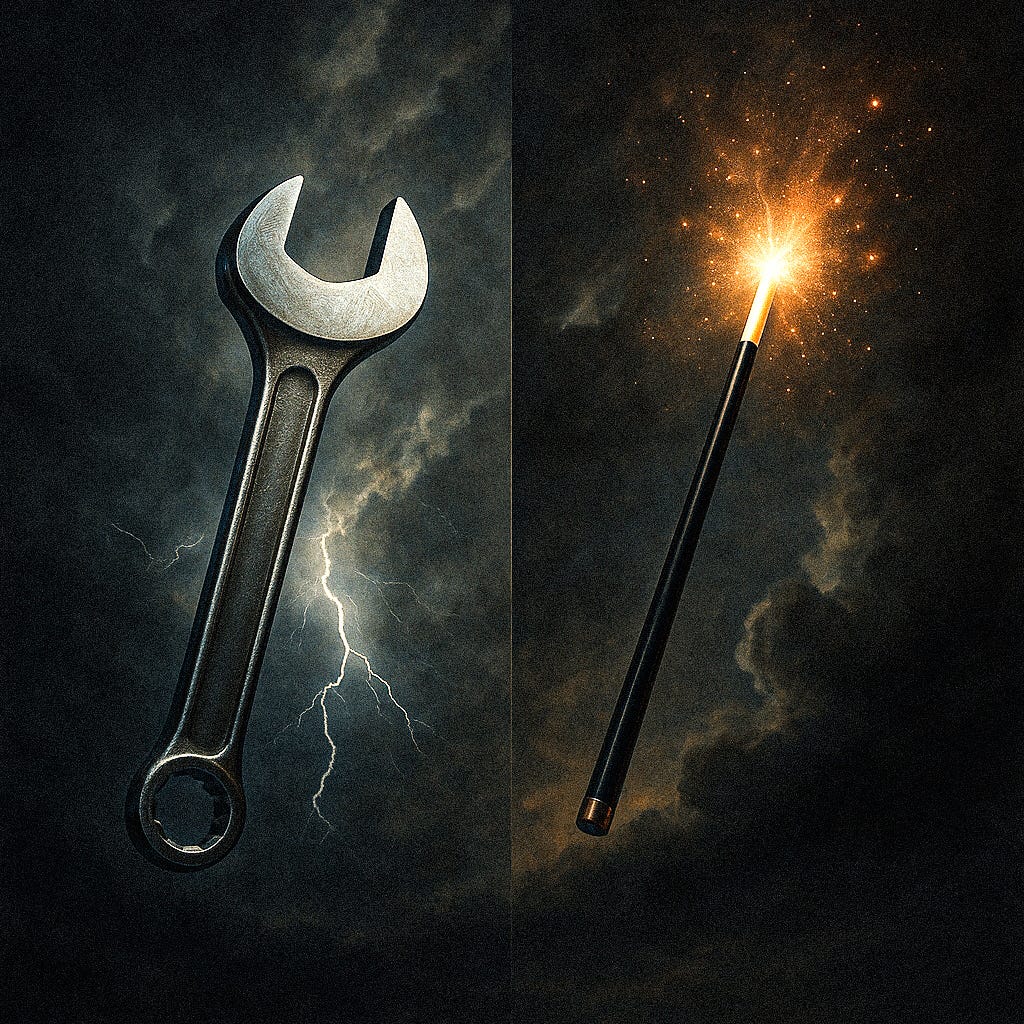
Democracy’s greatest flaw is that it requires constant work. It’s not a monument. It’s a machine. It needs maintenance, upgrades, lubrication, rebalancing. It needs patience, literacy, and participation — not once every five years but continually.
But modern people don’t want maintenance.
They want resolution.
They want a final answer, a policy that tidies up the mess, a leader who can deliver certainty. Democracy isn’t built for that. It’s built for negotiation, compromise, friction, disagreement — for the endlessly untidy business of living among people who don’t think like you.
And so the strongman’s offer becomes seductive:
“I’ll simplify the world.”
“I’ll speak for you.”
“I’ll end the chaos.”
“I’ll take control.”
It’s an illusion, of course. But a powerful one — especially in systems that haven’t been updated in decades.
China offers one version of the illusion. Hungary another. El Salvador, Turkey, Venezuela — each has its own flavour. Even democratic countries flirt with the idea: “Wouldn’t things run better if someone just took charge?”
This isn’t stupidity.
It’s democratic exhaustion.
III. The Unpatched West — Our Operating System No Longer Fits the World
The truth is uncomfortable but simple:
We’re running a 2025 civilisation on a 1944 democratic operating system.
The institutions built after World War II were designed for a world of:
slow information
limited capital flows
stable citizenship
strong unions
gradual technological change
predictable geopolitics
Western dominance
That world no longer exists.
We now live in a world of:
algorithmic manipulation
instantaneous disinformation
hyper-financialisation
weakened civic institutions
global capital without borders
multipolar power
cultural fracturing
popular impatience
political theatre
Our democratic OS hasn’t been patched to handle any of it.
So the system stalls. Freezes. Crashes. Glitches. Upgrades fail. Patches don’t install.
And into that frozen system walk the opportunists — the ones who thrive in the lag, who exploit the cracks, who weaponise the frustrations of people stuck inside a machine that no longer responds to them.
IV. The Stress Test: Strongmen Exploit Cracks — They Don’t Create Them
Whenever a strongman figure rises — whether in America, Russia, China, Hungary, Brazil, or elsewhere — commentators obsess over the personality.
But the personality is the least interesting part.
What matters is the infrastructure that allows that personality to thrive.
Autocrats don’t build the cracks.
They just know where to stand.
A political system that hasn’t been modernised is the perfect environment for:
leaders who promise closure
financiers who want deregulated power
media systems built on outrage
parties hollowed out by donor interests
populations seduced by simplicity
external powers eager to exploit democratic fatigue
Fiona Hill — speaking from the inside — describes how easily modern authoritarians manipulate outdated democratic instincts. Scaramucci warns how quickly capital networks fill political vacuums.
But again: they’re describing symptoms.
The underlying weakness is systemic.
V. What Actually Needs Updating — and Why It’s Collective Work
If democracies are machines, then we need to rebuild the service manual. Four areas, in particular, require urgent updating:
1. Institutional Upgrades
Democracies need modern guardrails:
independent regulators
transparent elections
checks on concentrated power
rules that match the digital age
Not glamorous work — but indispensable.
2. Economic Upgrades
The drift toward oligarchic capture is real because:
capital is faster than law
regulatory capture is easy
inequality is corrosive
labour protections have eroded
Democracy survives only when people feel the system still represents them.
3. Information Upgrades
The information sphere is the new battleground:
algorithms reward outrage
foreign states exploit fracture points
emotional manipulation outpaces literacy
We need democratic tools that match the speed and complexity of this environment.
4. Civic Upgrades
Democracy is not a spectator sport.
It requires:
participation
patience
understanding
responsibility
Without civic renewal, no institutional reform can hold.
VI. Why Revolution Isn’t the Answer — Renewal Is
Strongmen always offer the same deal:
“Tear it all down and trust me.”
It’s a con.
Revolutions replace problems with disasters.
Autocrats replace institutions with patronage.
The supposed “reset” simply creates a new ruling class.
Democracy doesn’t need demolition.
It needs a service, an overhaul, and a team of citizens who understand that maintenance is not optional.
We don’t need a new system.
We need a new version of the system.
VII. Pressing the Update Button — The Work We Must Do Together
The crisis of the West is not a crisis of ideology.
It’s a crisis of neglect.
Democracies aren’t failing because authoritarianism is strong.
They’re failing because democracy has been treated as self-sustaining — something that can run indefinitely without participation, without vigilance, without updating.
But systems do not update themselves.
And if we don’t update them, someone else will rewrite them for us — oligarchs, strongmen, external powers, or forces of chaos.
The update button is still there.
It hasn’t disappeared.
But no one can press it for us!