

A Precarious Moment in Global Power
Introduction
For a decade, the world has lived under the shadow — and the spectacle — of the strongman. Trump in the United States. Putin in Russia. Erdoğan, Xi, Modi, Orbán, Netanyahu, and a dozen others drawing from the same playbook: present yourself as the singular force able to impose order on a chaotic world. For many, it was a comforting illusion. For others, a menace. But for everyone, supporter or critic, it was undeniably stabilising in its own strange way. Strongmen don’t just dominate politics; they dominate expectations.
But now something is shifting. Not in a dramatic, cinematic collapse — but in the subtler, more dangerous way that myths unravel: cracks appear first, then contradictions, then a widening gap between the image of strength and the reality underneath. And when two of the most iconic strongmen of the modern era — Donald Trump and Vladimir Putin — begin to wobble at the same time, the world feels the tremor.
This is not about whether you love them or loathe them. This is about the structural instability created when systems built on personal dominance start to fray. Trump’s coercive theatrics are losing their spell. Putin’s purges and battlefield anxieties reveal strain rather than control. Their oligarchs — once obedient beneficiaries of the system — are growing restless, watching their futures hang on the fortunes of a single man.
The strongman model requires one condition above all others: the leader must never appear weak. Today, both men do. And when strongmen shake, markets grow uneasy, institutions get jittery, and entire political landscapes start to shift beneath our feet.
What follows is a map of how we arrived at this precarious balancing act — and what it reveals about the wider world we are walking into.
Section 1
The Spectacle Starts to Falter:
Trump’s Magic Turns Against Him.
For years, Donald Trump relied on a peculiar kind of political alchemy: he could turn outrage into momentum, conflict into loyalty, and sheer showmanship into a form of power. What looked chaotic from the outside felt like strength to his supporters. He seemed untouchable — a man who could break rules, intimidate enemies, and demand fealty without consequence. It was dominance as theatre, and for a long time, the audience loved it.
But the power of a showman depends on the illusion. When the trick becomes predictable, the magic weakens. And that is precisely where Trump now finds himself. The more he tries to bully Republicans into defending him, the more desperate he appears. The force that once projected strength now exposes vulnerability. Even his base, loyal as ever, can sense the shift: the tone is off, the timing is wrong, the punches don’t land.
His threats no longer terrify wavering allies; they irritate them. His demands for loyalty no longer feel like commands from a dominant figure but pleas from a man cornered. And his political opponents — long accustomed to Trump’s intimidation routine — have begun responding with something far more damaging than outrage: indifference.
When a strongman starts shouting and fewer people flinch, the spell breaks. Trump’s aura was always his greatest weapon. Now it’s cracking. The show isn’t over, not by a long shot, but the crowd isn’t watching with the same breathless awe. They’ve seen the trick too many times. They know where the rabbit is hidden. The hole in the table is visible.
Trump is still dangerous, still influential, still capable of disruption. But for the first time since 2016, his performance is working against him. The theatrics that once made him powerful now expose the limits of the act.
Section 2
A Strain Behind the Curtain:
Putin’s War, Purges, and Quiet Desperation.
If Trump’s decline plays out in the open — loud, messy, theatrical — Putin’s unfolds in the dark corners of the Kremlin, where silence is the first sign of trouble. His authority has always rested on a carefully curated image: the steely, calculating master of Russia’s destiny, unchallenged at home and feared abroad. But even the most disciplined autocracy cannot hide the tell-tale signs of strain forever.
The Ukraine war is no longer a bold geopolitical gambit; it’s a grinding test of stamina, resources, and internal loyalty. Putin has tied his personal legitimacy to victory — or at least the appearance of inevitable success. Yet the battlefield is stubborn, unpredictable, and increasingly costly. Every setback requires a new spin. Every casualty demands a new justification. Every stalled advance creates new cracks in the narrative.
And he knows it. The recent purges tell the story more clearly than any press conference. Senior officials quietly removed for “misalignment.” Generals shuffled around like pieces on a chessboard he no longer fully controls. Power blocs he once balanced with ease are now being micromanaged out of fear they might be thinking too independently. This is not the posture of a confident ruler. It’s the posture of a man trying to keep the ceiling from sagging.
The economy, meanwhile, remains officially “strong,” but the façade is slipping. Russia is sustaining itself with wartime improvisation — redirected budgets, inflated statistics, patriotic messaging, and a population told to swallow hardship as a form of loyalty. Beneath the bravado lies a troubled reality: sanctions biting deeper, skilled workers fleeing, inflation creeping, and public tolerance wearing thin.
Rumours of spreading Russian influence into places like Venezuela only make the domestic irritations sharper. Ordinary Russians have always tolerated foreign adventurism when times were good — but times are no longer good. The question “Why are we funding this?” becomes harder to silence.
Putin is still dangerous, still calculating, still capable of sudden escalation. But the certainty surrounding him has faded. The man who once looked like an immovable fixture of global politics now stands on shifting ground. Like all strongmen, he must project absolute control — yet the more he asserts it, the more obvious the strain becomes.
Section 3
The Myth Erodes:
When Strongmen Lose Their Symbolic Power.
Trump and Putin exist in different cultures, different systems, and different realities — yet they share something far more important than geography or ideology: they occupy the same space in the global imagination. They are archetypes of the “strongman leader,” the sort of figure who promises order through force, certainty through willpower, and stability through personal dominance.
For their supporters, this myth has been intoxicating. Trump was the blunt instrument who would smash the elites. Putin was the iron hand defending tradition and national pride. Neither image depended much on truth; it depended on the sense that these men were carved from a tougher material than ordinary politicians.
But strongmen draw their power not from institutions — which they often undermine — but from the perception of invulnerability. And that perception is now cracking on two fronts simultaneously.
Trump looks cornered, reactive, and increasingly frantic. Putin looks strained, pressured, and dangerously isolated.
This erodes the mythology they both rely on. And the erosion is contagious. The MAGA faithful who once envied Putin’s “strength” now see a man bogged down, purging subordinates, unable to claim a clean victory. The Russian ultranationalists who admired Trump’s brashness now see a man tied up in courtrooms and struggling to control his own party.
Strongmen reinforce one another symbolically. And they weaken one another symbolically.
When one falters, the myth frays. When two falter, the myth begins to look threadbare.
This matters because their strength has always been rooted in image. The strongman must look like the last stable pillar in a chaotic world. But the world is watching, and the cracks are visible. Each man’s vulnerability reflects onto the other. Each wobble diminishes the aura that once made them formidable.
For the first time in years, the global mythology of the strongman no longer looks inevitable. It looks dated. It looks tired. And it looks increasingly at odds with the reality on the ground.
Section 4
Markets Smell the Wobble:
When Strongmen Lose Their Grip, Investors Get Nervous.
Strongmen may horrify moralists and delight populists, but to markets they’ve always been a known quantity. Unethical? Often. Heavy-handed? Certainly. But predictable enough to price into the system. Markets can live with corruption, censorship, and even war — so long as the man at the top appears firmly in control and the rules, however twisted, don’t suddenly change.
But here’s the thing: markets absolutely hate uncertainty. And nothing generates uncertainty faster than a strongman who no longer looks strong.
Trump’s political chaos is creeping into economic sentiment. Investors see instability where they once saw “disruption that pays.” The court cases, the erratic decisions, the thinning loyalty among Republicans — these don’t just scream political risk; they scream volatility.
Meanwhile, Putin’s war-battered economy is propped up by emergency measures and narrative scaffolding. Oil is discounted, the rouble is artificially supported, military spending distorts GDP, and sanctions are gnawing through the wiring behind the walls. The official numbers say “resilient.” The market behaviours say “fragile.”
When two strongmen wobble at once, markets don’t see two isolated events. They see:
rising geopolitical unpredictability,
shaky supply lines,
confused energy markets,
shifting alliances,
increased risk premiums,
and nervous oligarchic networks moving money in strange ways.
This is the kind of background noise that keeps institutional investors awake at night — not because they favour one side or the other, but because fluidity is expensive.
Markets don’t need stability to be moral. They need stability to be profitable.
And right now, the world’s two most iconic strongmen are introducing a level of ambiguity that the global economic system simply cannot price neatly. When strongmen weaken, markets twitch — and we’re seeing precisely that twitch now.
It isn’t panic. But it is a tightening of the jaw.
Section 5
The Oligarchic Pact Starts to Flex:
Loyalty Built on Fear Begins to Waver.
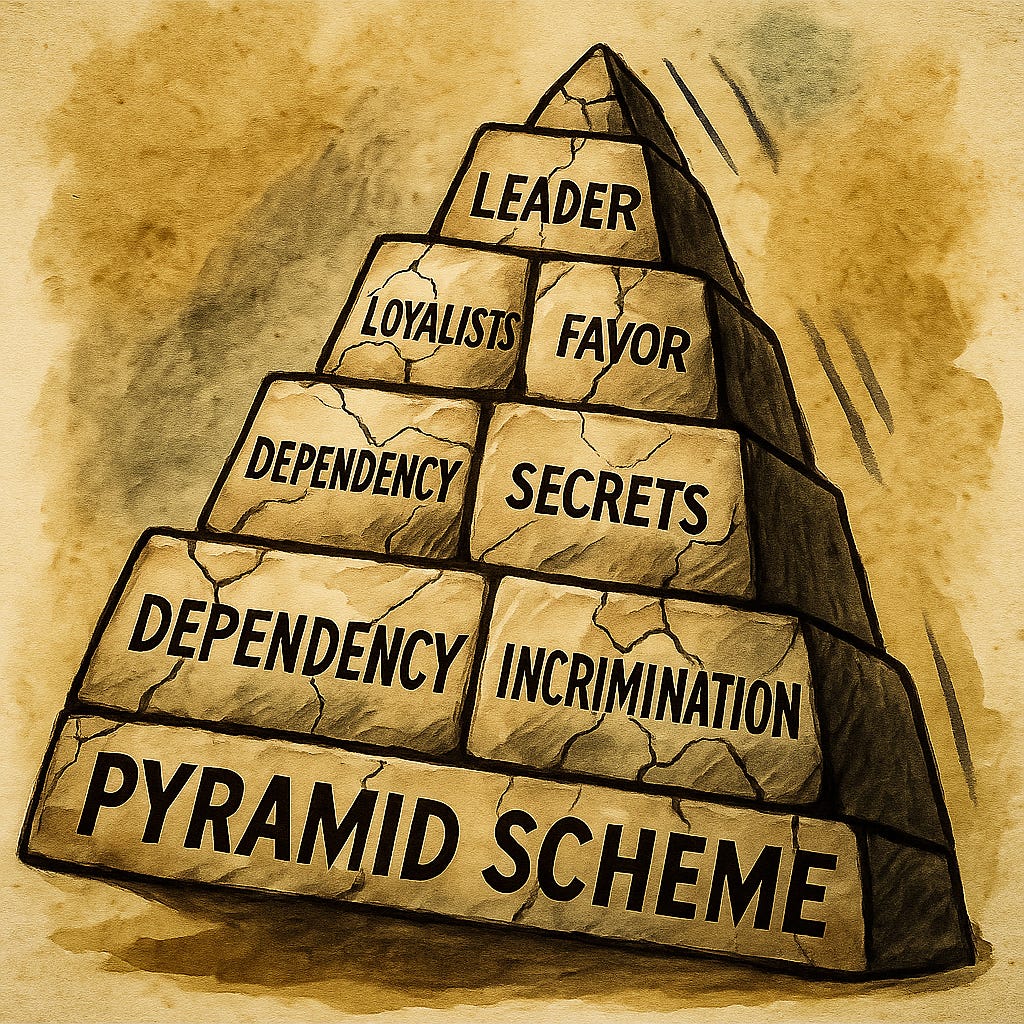
Strongmen do not rule alone. They sit atop a pyramid of people who depend on their survival — the oligarchs, donors, fixers, media barons, political enforcers, and shadowy middle-men who keep the machinery humming. These networks aren’t ideological movements. They’re business partnerships built on fear, favour, and mutual incrimination.
The arrangement is simple: “You keep me safe from the law, and I keep you rich.”
As long as the leader looks invincible, everyone stays loyal. The moment he looks vulnerable, loyalty becomes a liability.
This is the phase we’re entering now — in Trump’s circle and in Putin’s empire.
In the U.S., Trump’s loyalists sense exposure. The ones who screamed loudest for him yesterday are the ones hiring lawyers today. The big donors who once treated him as a golden ticket now treat him as a legal hazard. The political parasites who fed on his momentum are quietly drifting toward whichever Republican seems less radioactive.
In Russia, the signs are louder. Oligarchs moving assets offshore. Tech elites fleeing. Military commanders mysteriously “reassigned.” Business leaders suddenly dying in “accidents” that look anything but accidental. These aren’t signs of stability; they’re signs of internal fear — people trying to get out of the blast radius without making too much noise.
Strongmen always have loyalists. What matters is what the smart loyalists do. And the smart ones are hedging.
The oligarchic pact depends on the leader looking unstoppable. When he doesn’t, the pact frays. Not explosively at first — but subtly, through evasions and excuses, missed calls and quiet withdrawals of support. The circle becomes smaller. The paranoia grows larger. And the entire structure becomes more brittle.
This isn’t collapse. It’s the pre-collapse choreography. The same steps appear in every personalist regime — from Berlusconi to Chávez, from Mugabe to Erdoğan, from Marcos to the late Soviet elite.
Before the fall comes the hesitation. And hesitation is exactly what we are starting to see.
Section 6
The Feedback Loop of Decline:
When Vulnerability Becomes Self-Fueling.
Strongmen don’t collapse all at once. They unravel through a feedback loop — a slow-burning cycle of insecurity that becomes more visible with each turn. It begins quietly, in the private anxieties of the inner circle, and eventually spills into public view as missteps, purges, erratic decisions, and tightening paranoia. And once the loop begins, it’s almost impossible to reverse.
The sequence is always the same:
A. The leader senses instability. Something shifts — a court case, a battlefield loss, a poll, a budget strain, a betrayal. It doesn’t matter what the trigger is; what matters is the perception that the ground is no longer solid.
B. He demands loyalty to reassert control. The pressure increases. Tests of allegiance become more frequent. Allies are told to prove their devotion — loudly, publicly, aggressively.
C. Loyalists comply… until the smart ones don’t. The truly loyal shout even louder. But the clever ones grow cautious, evasive, subtle. They start hedging, delaying decisions, avoiding risk.
D. The leader interprets hesitation as treachery. This is the turning point. He purges the wrong people, keeps the wrong people, promotes sycophants, and alienates the competent. Control narrows. Paranoia widens.
E. The system becomes less capable and more afraid. Decisions slow down. Information is filtered. Mistakes multiply. No one wants to deliver bad news, so the leader makes worse choices based on fantasy instead of reality.
F. The public begins to see the cracks. The man who once appeared decisive now looks cornered. The man who once inspired fear now inspires confusion. The aura fades.
G. The oligarchs panic — and their panic accelerates the decline. Money moves. Influence shifts. Quiet alliances form. The regime becomes unstable from within, not because of external pressure.
This is the death spiral of personalist power. Not a dramatic fall from a cliff, but a staircase of compounding miscalculations.
Trump is walking those steps politically. Putin is walking them geopolitically.
Different worlds, same spiral.
What makes the moment so precarious is that both spirals are happening at the same time — and each wobble amplifies the other in the global psyche. The strongman myth relies on the belief that these men are unshakeable. The reality is showing something very different: insecurity feeding insecurity, weakness creating more weakness, and a model of leadership struggling to sustain its own image.
When strongmen fight to preserve their aura, they don’t steady the ship — they tilt it.
And right now, the tilt is unmistakable.
Section 7
A Global Balancing Act:
The World Feels the Strain of Two Fading Strongmen.
Individually, Trump and Putin are disruptive figures. Simultaneously, they represent something more: the weakening pillars of a political era defined by personalistic power. Their decline isn’t just a personal drama — it’s a structural strain on the global system, because strongman leadership isn’t isolated. It’s interconnected, symbolic, and contagious.
When one strongman falters, his followers feel uneasy. When two falter, the entire ecosystem of strongman politics begins to tremble.
This is the moment we find ourselves in now.
Trump’s grip on his movement is slipping. He’s louder but less effective, angrier but less feared. His legal troubles, political miscalculations, and increasingly frantic demands for loyalty make him look like a man fighting shadows rather than shaping events. The myth of his inevitability — the backbone of his influence — is cracking.
Putin, on the other hand, is no longer projecting the cool certainty that once defined him. The war he expected to be quick has become a grinding liability. His purges, once strategic, now look like flailing attempts to keep factions in line. The Russian public, stoic as ever, is beginning to show signs of fatigue. And the elites — the ones who matter — are quietly recalculating their futures.
And here’s the uncomfortable truth: the system that grew around these men depends on them appearing untouchable.
When they don’t, several things happen at once:
Markets wobble, sensing risk and unpredictability.
Allies doubt, wondering whether alignment still pays.
Opponents grow bolder, sensing weakness.
Internal rivals sharpen their knives, both literally and politically.
The public grows anxious, uncertain who will fill the vacuum.
Other strongmen take note, adjusting their own strategies out of fear.
It becomes a global balancing act where no one feels entirely secure — not democracies, not autocracies, not financial systems, not military alliances. The world doesn’t need strongmen to admire them; it needs them to at least appear predictable. And right now, predictability is in short supply.
Trump is stumbling. Putin is straining.
And the ideological fantasy they helped animate — the fantasy of the unstoppable, unshakeable strong leader — is showing its age. Whether these men fall or cling on is almost secondary. What matters is that the illusion has cracked, and once illusions crack, they rarely mend cleanly.
We are in a moment where confidence is diminishing, uncertainty is growing, and two of the most symbolic leaders of the strongman era are fighting battles they cannot afford to lose. And the world, watching from the sidelines, feels the tremor.
This is the precarious balancing act of today — not just political, but psychological, financial, and global in scope.
Epilogue
The Currency of Power:
Why Some Men Recognise Each Other Instantly.
Not all power is political. Some of it lives in the shadows — in whispered favours, compromising secrets, and the quiet terror of mutual dependency. Long before Donald Trump entered politics, and long before Vladimir Putin reshaped Russia in his own image, there existed another kind of operator who understood this world intimately:
Jeffrey Epstein.
On the surface, Epstein seems irrelevant to Trump and Putin. No ideology. No armies. No elections. No geopolitical footprint. But in the structure of power — the hidden wiring behind the walls — the parallels are unmistakable.
Epstein built miniatures of the same systems strongmen build on a national scale: pyramids of dependency, networks of favours, circles bound by silence and mutual incrimination. His currency wasn’t votes or tanks. It was shame. Leverage. Access. Temptation. Compromise. And fear.
Strongmen and shadow brokers use different tools, but they thrive in the same psychological soil: “Stay close to me, and you are safe. Leave me, and you are exposed.”
That is why Trump and Epstein recognised each other so easily. Not because they shared tastes. Not because they shared politics. But because they understood the same architecture of influence — how to bind people with what they desire and what they dread, how to turn weakness into obedience, and how to make silence more valuable than truth.
For men who operate this way, the world divides into two groups: those who can be used, and those who can be dangerous.
It is the same logic that sustains oligarchs around Putin. The same logic that binds political loyalists to Trump. The same logic that holds any personalist power structure together until the moment the centre weakens.
Because here’s the unwritten rule: Once the person at the top loses control, everyone beneath is suddenly in peril. There is no soft landing for a pyramid built on secrets.
Epstein’s world collapsed in days when he ceased to look untouchable. Trump’s world strains when he looks legally cornered. Putin’s world tightens when the war drags on.
Different scales. Same structure. Same fear. Same fragility.
And perhaps that is the clearest lesson of this moment: Power built through intimidation and dependency does not fade gracefully. It fractures. It retreats into paranoia. It turns on itself. And it leaves everyone who once felt protected suddenly exposed.
In the end, the strongman’s kingdom — whether cast in gold, oil, propaganda, or secrets — rests on a single unspoken truth: it works only as long as he appears invincible.
Today, invincibility is in short supply.
And the world can feel it.
Written by Eric Wigart Fri 14 Nov 2025
If you enjoyed this piece, feel free to subscribe to follow my work.