

Introduction
These three essays examine how power operates before it is formalised — through behaviour, interpretation, and procedure rather than explicit control.
Written from different angles, they move from individual mechanism, through institutional meaning-making, to the consequences of getting process wrong. Together, they describe a condition in which authority consolidates quietly, coherence weakens, and trust erodes long before any visible rupture.
They are not sequential.
Each stands alone.
Read together, they trace the same pressure moving through different layers of society.
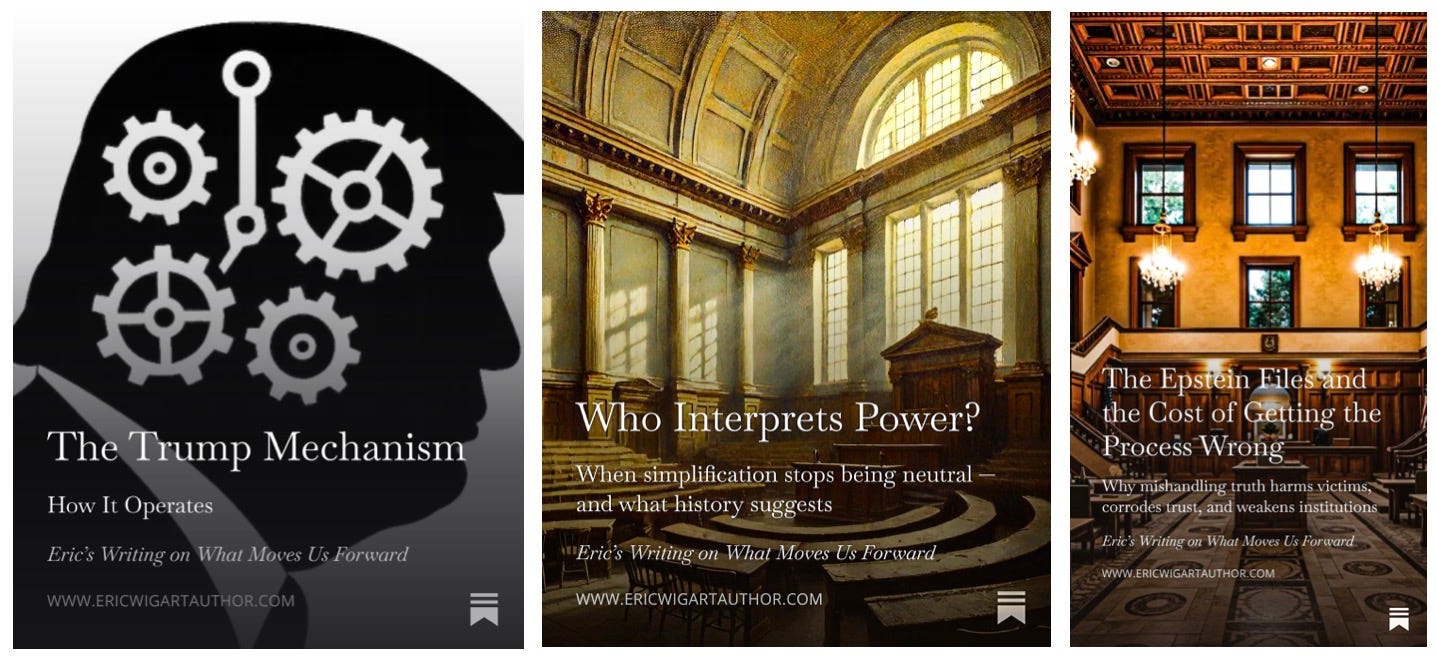
The Trump Mechanism
How it operates
An analysis of Donald Trump not as ideology or policy, but as a behavioural system.
The essay examines how contradiction, emotional control, and narrative instability function as tools — shaping attention and loyalty without requiring coherence or resolution.

Who Interprets Power?
When simplification stops being neutral
A reflection on how authority consolidates through interpretation rather than force.
As systems grow more complex, explanation itself becomes infrastructure — determining what is legible, contestable, or ignored, long before formal decisions are made.

The Epstein Files and the Cost of Getting the Process Wrong
Why mishandling truth harms victims and weakens institutions
A case study in institutional failure under pressure.
The focus is not on scandal, but on procedure: how disclosure without structure, outrage without method, and restraint without explanation corrode trust and ultimately damage the very systems meant to establish truth.

These 3 Essays:
Do not argue toward a single conclusion. They describe how power behaves when interpretation outruns responsibility.