

Introduction
We tend to think of choice as something that happens first.
A decision is made. An action follows. The world responds.
Structure, in this view, is secondary — a backdrop against which intention plays out.
But lived experience rarely follows that order.
Long before we decide anything, we are already somewhere.
Within rooms, routines, systems, habits, institutions, and rhythms that were not chosen by us — and yet shape what can be chosen next. These structures do not announce themselves. They do not argue or persuade. They simply hold, long enough for repetition to take place.
Over time, what holds begins to matter.
Patterns stabilise. Certain movements become easy to repeat. Others quietly demand more effort. Nothing dramatic occurs. No rules are declared. And yet outcomes begin to diverge — not because of intention, but because continuity always favours what already fits.
This weekend and into Monday, three connected pieces will be published that explore this terrain from different angles.
Not power in the sense of command, and not freedom in the sense of escape — but the quieter mechanics of persistence: how environments shape behaviour without directing it, how necessity slowly loses neutrality through time, and how orientation emerges as a practical response to conditions that do not move simply because we wish them to.
Read together, the essays trace a progression.
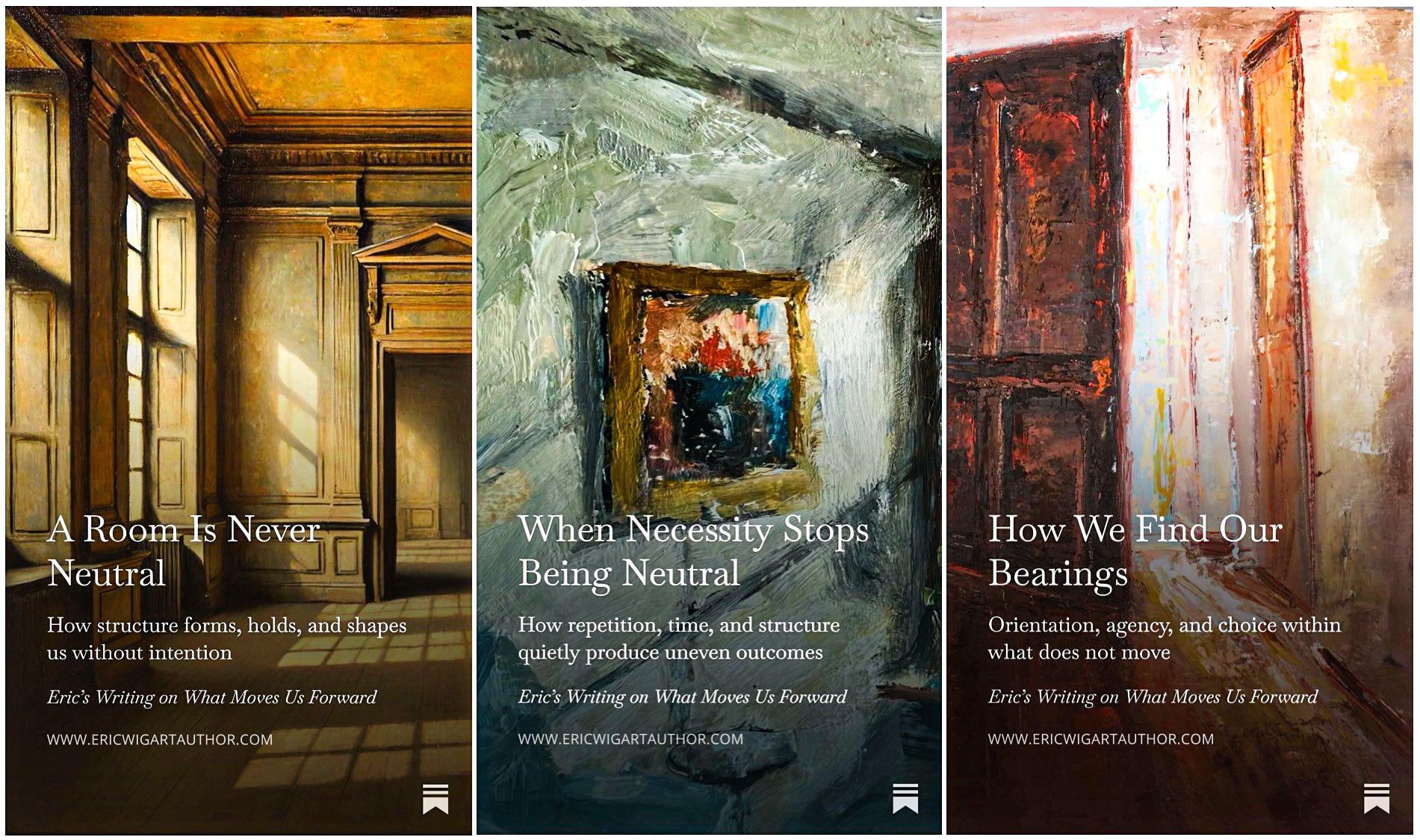
The first looks at structure as something that forms and holds without intent — how stability itself begins to guide behaviour long before we notice it doing so.
The second follows that stability through time, showing how repetition and preservation produce uneven outcomes even in the absence of design or malice — and why necessity, once depended upon, can no longer be experienced as neutral.
The third turns to orientation: not as preference or belief, but as a functional requirement of persistence — how agency arises within constraint, and why choice only becomes meaningful once position is legible.
None of these pieces argue for dismantling structure, or escaping it. Without what holds, nothing continues long enough to matter. The question is not whether structure should exist, but what happens once life depends on it — and what changes when we begin to see where we are standing.
This introduction is not a summary, and not a guide.
It is a place to pause before entering.