

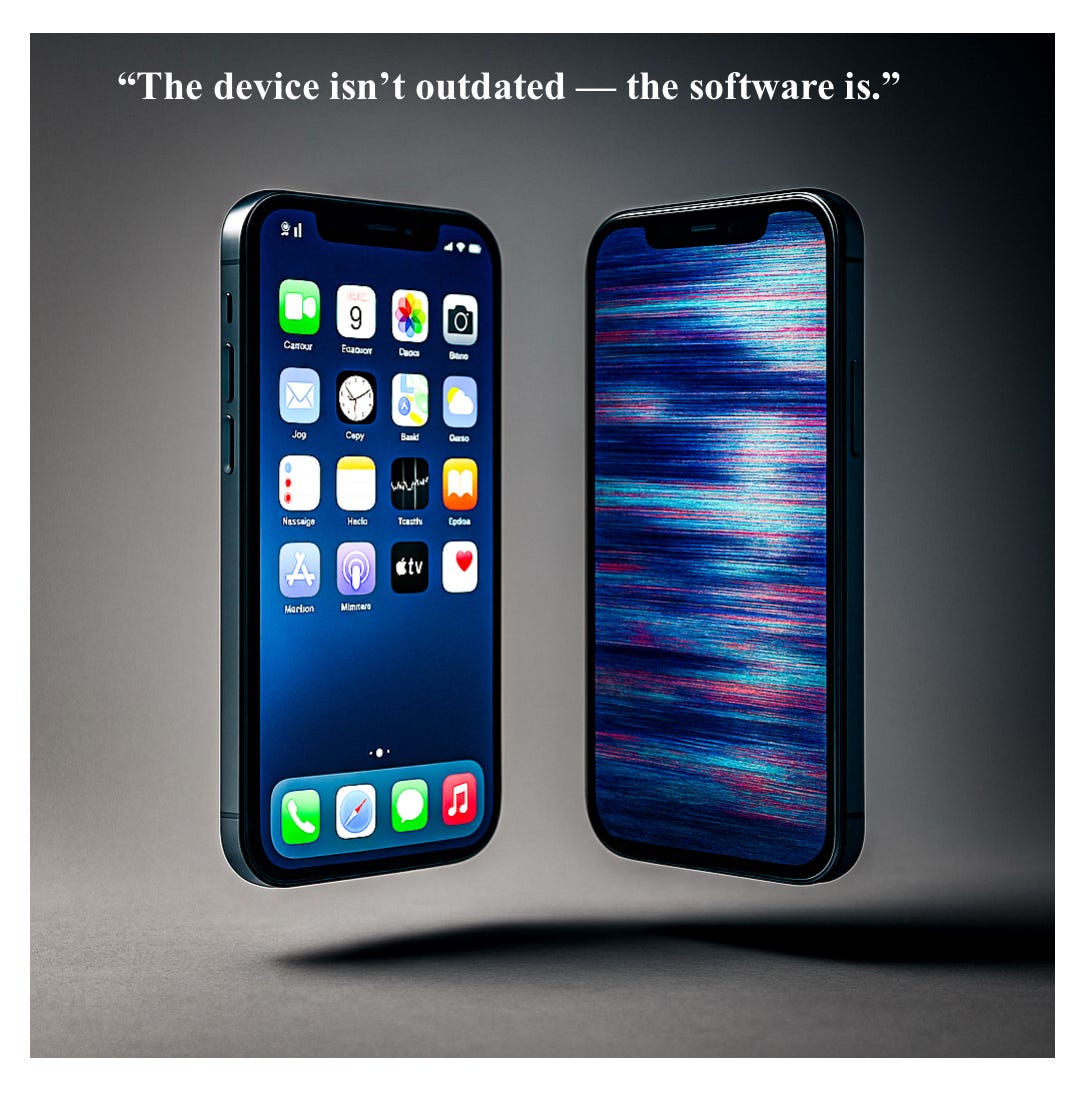
We all know what happens when you ignore your iPhone updates.
First the apps misbehave.
Then the battery collapses.
Eventually the entire device grinds along like a half-retired pensioner, and Apple gently informs you that your once-beautiful phone is now “no longer supported.”
The phone wasn’t the problem.
The lack of updates was.
Democracy and the Bretton Woods system suffered the same fate.
Both were brilliant.
Both were elegant.
Both were built for a world that no longer exists.
And both were treated like sacred scripture — frozen, untouchable, unimprovable — instead of living systems that needed continual maintenance.
Today, we’re running a 2025 civilisation on a 1944 operating system.
Of course it’s lagging.
Of course it’s crashing.
We simply never pressed “update.”
Democracy is the handset.
Bretton Woods was the operating system.
Democracy is the hardware — the physical device, the architecture of legitimacy.
Bretton Woods was the software — the rules, trade structures, currency stability, labour protections, and global balance that made the democratic device actually run.
The two were never designed to be timeless.
They were designed to evolve, patch, and upgrade as the world changed.
But we treated them like Biblical tablets: revered, respected… and never revised.
The world changed. We didn’t.
Every time history demanded a system update, we pretended nothing was wrong.
1971: Nixon ends the gold standard → OS patch ignored
1980s–90s: Unions gutted → security layer removed
1990s: Hyper-globalisation → bandwidth mismatch
2001: China enters WTO → firmware conflict
2008: Economic crash → battery meltdown
2020s: AI arrives → processor too old to cope
All of this required redesign and reinvention.
Instead, we crossed our fingers and hoped everything would “just work.”
It didn’t.
It couldn’t.
Good systems don’t fail.
Ignored systems fail.
Into this frustration walks the populist salesman
When people feel trapped with an un-updated device that barely functions, they don’t blame themselves — they blame the device.
And that creates a perfect opening for the man with the wrecking ball wrapped in gold foil.
The populist pitch is always the same:
“Your system is slow. The apps don’t run. The battery dies.
Don’t update it — smash it.
I can give you something new.”
But what’s being sold isn’t new at all.
It’s a familiar old product: autocracy, repackaged as disruption.
Not the ideological autocracy of the 20th century.
Not communism.
Not fascism.
This is something far more modern:
corporate autocracy — authoritarianism run on market logic.
Putin perfected the model. Trump is drifting straight toward it.
Putin’s system is a fusion of:
centralised power,
super-rich loyalists,
state capture,
media control,
and capitalism stripped of guardrails.
A dictatorship conducted through contracts instead of commissars.
A regime where wealth replaces ideology as the tool of control.
Trump isn’t the architect of this model — he’s simply drawn to it because it suits his instincts:
loyalty over law,
profit over principle,
personal power over institutional order.
And behind him sits the American version of Putin’s oligarchs:
the mega-donors, the billionaires, the think tanks, the Heritage Foundation, Project 2025.
Different vocabulary.
Same structure.
Putin uses state-connected oligarchs.
Trump leans on private capital networks that want to turn the state into a franchise.
The Russian model creates oligarchs from the state.
The American model lets oligarchs remake the state.
Either way, the result is the same:
Centralised power + unregulated capitalism = modern autocracy.
This is what happens when systems don’t update
Democracy didn’t break.
We simply didn’t maintain it.
Bretton Woods didn’t collapse under its own weight.
We let it expire.
Populism is not the cause — it’s the effect.
It fills the vacuum left by systems that were never patched, never modernised, never adapted to the world they’re supposed to govern.
And once corporate autocracy takes root, it doesn’t need gulags or ideology.
It uses:
contracts,
patronage,
blacklisting,
regulatory intimidation,
algorithmic control,
and debt.
It’s softer to the touch — and far more effective.
A dictatorship that looks like a business plan.
So where does that leave us?
The solution is not to smash the device.
It’s to update it.
A responsible iPhone owner keeps the OS current, swaps the battery when needed, and upgrades the handset when the time comes.
A careless owner ends up with a brick and unnecessary frustration.
Civilisation is no different.
Democracy doesn’t need to be replaced with an authoritarian landline.
It needs a new OS or a major patch — the modern equivalent of Bretton Woods 2.0.
We keep the hardware.
We update the software.
We maintain the system.
Because “abolish and replace” isn’t a solution —
it’s a sales pitch for people selling autocracy as innovation.
Press “update.”