

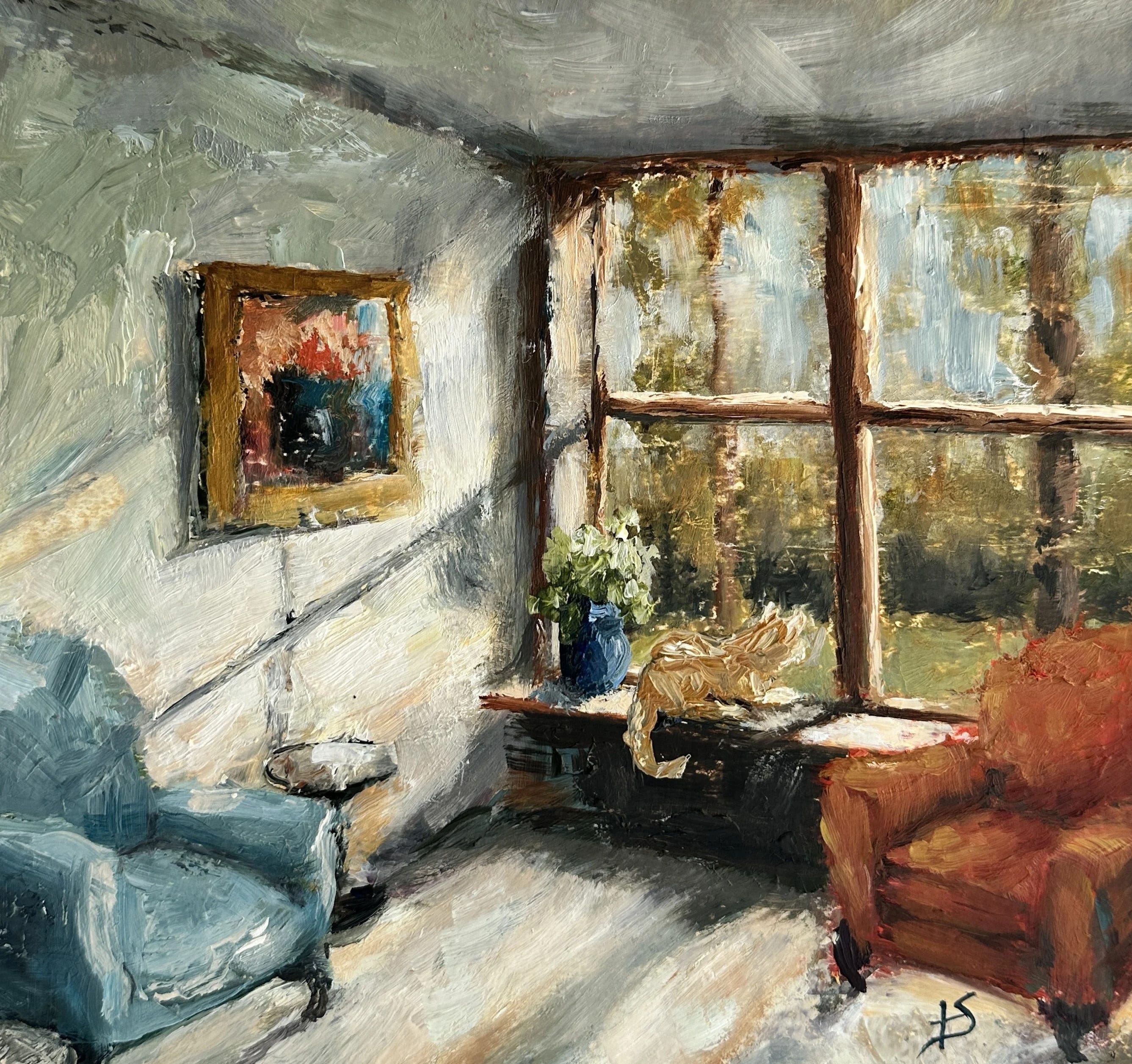
A Room Is Required
It’s tempting to treat rooms as optional.
We think of them as settings — places where things happen once something more important is already underway. The action precedes the space. The room merely receives it. If nothing occurs, the room feels empty, incidental, even unnecessary.
But this assumption reverses the order of things.
Nothing begins without somewhere for it to begin. Nothing continues without somewhere for it to remain. Before movement, before intention, before meaning, there must be a place that holds long enough for any of it to matter.
A room is not a backdrop.
It is a condition.
Without containment, nothing persists. An action without somewhere to land dissipates immediately. A presence without boundaries dissolves into noise. Even the most fleeting gesture requires a minimum of stability to be recognised as having happened at all.
Consider how little it takes for something to fail to exist.
A sound that does not travel through air is not heard. A step that does not complete is not a movement. A pattern that does not repeat leaves no trace. What we call existence depends less on origin than on endurance — on the ability of something to remain present long enough to be experienced.
This is where the room quietly enters the story.
A room does not create life. It does not generate movement. It does not supply meaning. But it provides the necessary condition for all three. It allows things to linger. It gives duration somewhere to accumulate. It permits repetition to occur without immediately collapsing back into absence.
A space that cannot hold is not a room.
It is a gap.
Even emptiness requires structure to be noticed. An open field, a shoreline, a stretch of road — each becomes perceptible not because it is filled, but because it remains. We register it as space only because it does not vanish the moment we arrive.
Persistence precedes perception.
What Allows Anything to Continue
This is easier to feel than to articulate, which is why it so often goes unnoticed.
We tend to focus on what moves, not on what allows movement to complete. We attend to events, decisions, changes — not to the quiet continuity that makes them possible. Yet remove that continuity and nothing survives long enough to become an event at all.
A room that exists for an instant is not a room.
A place that cannot endure cannot contain.
This is not a metaphor. It is an everyday condition.
Every action you recognise as having occurred required a minimum stretch of duration in which to unfold. Every habit required enough stability to repeat. Every life required a structure capable of sustaining rhythm — breath after breath, step after step, day after day.
Continuity is not an extra feature layered on top of existence.
It is the price of admission.
This is why disruption alone cannot produce life. Novelty alone cannot sustain it. Change requires a base that holds while change happens. Even chaos needs a frame if it is to be experienced as chaos rather than disappearance.
A room provides that frame.
Not by instructing what should occur, but by remaining present long enough for anything to occur repeatedly. Its boundaries do not dictate behaviour, but they allow behaviour to take shape. They keep actions from evaporating the moment they begin.
This is also why preservation appears so early in the story of life.
Anything that lives must, in some form, preserve itself — not out of desire, but out of necessity. Preservation is what allows continuation. Continuation is what allows change. Without something held steady, nothing can adapt.
A room does this without intention.
It holds not because it chooses to, but because it exists in a way that allows endurance. Its walls are not goals. Its limits are not values. They are simply conditions under which repetition becomes possible.
Once repetition is possible, something remarkable happens.
Movement can complete.
Patterns can form.
Rhythms can emerge.
And only then can anything be said to be alive in a meaningful sense — not because it moves once, but because it moves again.
This is why life is inseparable from structure.
Not imposed structure. Not designed structure. But structure that persists long enough to support cycles: intake and release, rest and motion, variation and return. Strip away that support and life does not struggle — it simply cannot continue.
The room does not explain this.
It demonstrates it.
By holding.
By remaining.
By allowing duration to accumulate.
We rarely notice this because it works too well. The room’s success is its invisibility. When continuity is uninterrupted, we take it for granted. We treat persistence as a background condition, forgetting that without it nothing we value could appear at all.
This is why rooms feel neutral — until they don’t.
Nothing Moves Without Time
We speak about movement as though it were instantaneous.
A step. A turn. A change of direction. We name the result and forget the process that made it possible. Movement appears as a fact, not as something that had to take place.
But no movement exists at a point.
A step that does not complete is not a step.
A gesture that does not unfold is not a gesture.
An action that cannot persist long enough to be recognised has not happened at all.
Movement requires more than space.
It requires duration.
This is easy to miss because duration is everywhere. It surrounds every action so completely that it disappears from view. We notice where something is, not how long it takes to become so. We see position, not the stretch of time that allowed the position to be reached.
Yet remove that stretch, and movement collapses.
An instant contains no action. It contains no rhythm, no sequence, no before and after. Nothing can change within it, because change is defined by transition — and transition requires time to pass.
This is why a room that cannot endure cannot support movement.
Without duration, repetition is impossible. Without repetition, no pattern can stabilise. Without stability, nothing that moves can move again in the same way. Every action would be a first and last, leaving no trace and no continuity behind it.
Life does not operate like that.
Life depends on movements that return. Breath that follows breath. Steps that echo earlier steps. Cycles that do not just occur once, but establish a rhythm that can be sustained. These movements are not remarkable individually. What matters is that they can happen again.
Time is what makes this possible.
Not as something measured, but as something that allows movement to finish, to repeat, to settle into form. It is the difference between an action flashing into existence and an action becoming part of a sequence. Between a moment and a process.
This is why nothing truly alive happens all at once.
Growth takes time because it must. Learning takes time because repetition is its substance. Recovery takes time because patterns cannot be replaced in an instant; they must be unwound and reformed across duration.
The room makes space available.
Time makes movement possible within it.
Together, they allow something crucial: the accumulation of experience.
Each movement leaves a residue — not because it is remembered consciously, but because it changes the conditions for what follows. The next movement begins from a slightly altered place. Over time, these small differences matter. They compound. They shape what becomes easy, what becomes likely, what becomes normal.
Without time, none of this occurs.
Without time, there is no “again”.
And without “again”, there is no life in any meaningful sense — only isolated events that cannot build upon themselves.
This is why time is never optional.
It is not an abstract dimension layered on top of space. It is the quiet requirement that allows anything in space to continue. It is what turns position into process, and presence into persistence.
We struggle to see this because we are taught to treat time as something we track, rather than something that makes existence possible at all. We learn to measure it, divide it, manage it — and in doing so, we lose sight of its deeper role.
Time is not what tells us when something happened.
It is what allows anything to happen more than once.
And once something can happen again, it can begin to live.
Without Structure, Nothing Lives
Once movement can repeat, something else begins to take shape.
Not intention.
Not design.
Not meaning.
Structure.
At first it is barely perceptible. A slight regularity. A tendency rather than a rule. Movements that return begin to align with one another. Sequences form. What happens next is no longer entirely independent of what happened before.
This is not imposed.
It is not chosen.
It emerges because repetition requires support.
Any movement that occurs more than once must do so under conditions that allow it to recur. Breath returns only if the body can maintain a rhythm. Steps repeat only if balance holds. Growth continues only if intake and release settle into a workable cycle.
Life does not begin with structure.
But it cannot continue without it.
This is why structure appears everywhere life persists — not as rigidity, but as reliability. A living system must be stable enough to repeat itself and flexible enough to vary. Too little structure and everything dissolves. Too much and nothing can adapt.
Between those extremes, life finds its footing.
Structure, in this sense, is not a constraint placed upon living things. It is the means by which living things remain present long enough to change. It holds continuity in place while variation occurs. It allows difference to accumulate without collapse.
Strip structure away and movement does not become free.
It becomes unsustainable.
Every action must start again from nothing. No rhythm can stabilise. No learning can take hold. No identity can form, because identity itself is nothing more than patterned repetition across time.
This is why even the most fluid forms of life are structured.
Waves repeat. Cells cycle. Habits form. Languages stabilise. Relationships develop rhythms. None of this requires a planner. All of it requires conditions that persist long enough for patterns to return.
Structure does not appear because something wants order.
It appears because order is what allows continuation.
Seen this way, structure is not opposed to life.
It is life’s scaffolding.
And like any scaffolding, it is meant to hold — not to explain itself. It does not announce its presence. It becomes visible only when it fails, or when it begins to press back against change.
This is where misunderstanding often begins.
Because structure supports life, we mistake it for purpose. Because it persists, we treat it as justified. Because it stabilises what works, we assume it reflects what should be.
But structure has no values.
It preserves what fits.
It amplifies what repeats.
It carries forward what survives.
What does not fit is not judged.
It is simply not supported.
This is how structure quietly shapes what lives on and what fades — not through choice, but through alignment. Patterns that can repeat within existing conditions endure. Those that cannot struggle to stabilise, regardless of their merit.
Life adapts to structure long before structure adapts to life.
This is why structure feels neutral from the inside. When it supports us, we barely notice it. Its rhythms feel natural. Its constraints feel reasonable. Its boundaries feel like common sense.
Only when we change — or try to — does structure reveal itself as something active.
But even then, it is not acting against life.
It is acting in favour of continuity.
That distinction matters.
Because once you see structure this way, it stops being something that can simply be removed, overthrown, or ignored. Without it, nothing persists. Without it, nothing moves again. Without it, nothing lives long enough to become itself.
Structure is not the opposite of freedom.
It is the condition under which freedom has time to appear.
The question is never whether structure should exist.
The question is what happens once life depends on it.
When Necessity Stops Being Neutral
Up to this point, everything still appears evenly shared.
A room that holds.
Time that allows movement.
Structure that makes life possible.
These conditions do not announce preference. They apply broadly. They feel impersonal, almost generous. Without them, nothing persists — so their presence appears unquestionably good.
And yet, something subtle begins to shift the longer life unfolds within them.
Because while these conditions are necessary for everything to live, they are not experienced equally by everything that lives.
Structure preserves what already fits.
This is not a flaw. It is how preservation works. Anything that endures must, by definition, favour what can repeat within existing conditions. Patterns that align with the room’s shape stabilise more easily. Movements that match established rhythms require less effort. Behaviours that sit comfortably within structure encounter less resistance.
Nothing has to decide this.
No intention is required.
Alignment alone is enough.
Over time, this alignment compounds. What fits moves more easily. What moves easily repeats. What repeats becomes normal. What becomes normal begins to feel natural — even inevitable.
This is how structure quietly accumulates advantage.
Not because it chooses winners, but because it reduces friction for those already aligned with it. Movement that flows is cheaper than movement that resists. Repetition that reinforces structure requires less energy than repetition that challenges it.
From inside, this still feels neutral.
Those who move easily within the room experience structure as support. Its limits feel sensible. Its rhythms feel obvious. Its boundaries feel like the way things simply are. There is no reason to question what does not press back.
But elsewhere in the same room, movement feels different.
For those less aligned, every action costs more. Repetition demands effort. Patterns struggle to stabilise. What others experience as continuity is experienced here as resistance. Not because the room rejects them, but because the room does not adjust.
Structure preserves continuity first.
Adaptation comes later — if it comes at all.
This is where neutrality quietly breaks down.
Not at the level of principle, but at the level of experience. The same structure that sustains life begins to shape which forms of life can persist with ease, and which must work harder simply to remain present.
Importantly, this does not require injustice, malice, or design.
It requires only time.
Given enough duration, even neutral conditions produce uneven outcomes. Small differences in fit accumulate. Minor frictions compound. What begins as variation settles into pattern.
And once pattern stabilises, it becomes harder to change — not because change is forbidden, but because the cost of moving against established structure is higher than the cost of moving with it.
This is why structure feels most neutral to those it supports best.
The room has not changed.
The conditions remain the same.
What has changed is position.
Standing in different places within the same structure produces different experiences of ease, effort, and possibility. Yet from the inside, each position can feel universal. What moves smoothly feels normal. What resists feels exceptional.
This is how necessity becomes consequential.
The room must hold for anything to live.
Time must allow movement to repeat.
Structure must preserve continuity.
But once life depends on these conditions, they can no longer be neutral in practice — because preservation, by its nature, carries forward what already fits.
This is not a critique.
It is a description.
And it leads to a final, unavoidable realisation:
Structure does not decide who belongs.
But it decides who can remain without struggle.
What Changes When You Notice
Nothing changes immediately.
The room remains.
The structure holds.
Time continues to pass.
Awareness does not loosen the walls or slow the rhythm. It does not rebalance effort or erase friction. Noticing does not grant leverage.
And yet, something has shifted.
What was previously experienced as background becomes foreground. What once felt natural is revealed as conditional. The ease or difficulty of movement is no longer taken as self-evident, but as positional.
This does not produce certainty.
It produces orientation.
You begin to see that what felt neutral was never universal — only consistent. That continuity did not emerge to favour you or oppose you, but simply to preserve itself. That the room has been holding all along, even as it quietly shaped what could repeat with ease and what could not.
This recognition does not demand judgement.
It does not ask you to blame the room, dismantle it, or replace it. Without the room, nothing would persist at all. Without structure, there would be no life to speak of, only isolated moments unable to build upon themselves.
What changes is not the structure, but your relationship to it.
You stop mistaking support for inevitability.
You stop mistaking resistance for failure.
You stop assuming that ease is proof of correctness, or that friction is proof of error.
Movement becomes legible again — not just where it flows, but where it costs.
This matters, because once you notice how structure preserves itself, you also notice where adaptation stalls. Where repetition reinforces the same paths. Where alternatives struggle not because they are wrong, but because they do not yet fit what is already holding.
At that point, neutrality becomes something you recognise as local, not absolute.
The room is still necessary.
Time still allows movement.
Structure still sustains life.
But you are no longer inside them blindly.
You begin to understand that change cannot occur by denial alone. It must take place within what holds, or alongside it, long enough to establish new repetition. Nothing replaces a structure overnight. Nothing living adapts in an instant.
Awareness does not make movement easy.
It makes movement intentional.
You see that endurance is not guaranteed. That patterns survive because they can, not because they should. That life persists not by purity, but by alignment with conditions that hold long enough for variation to take root.
This does not offer comfort.
But it offers clarity.
And clarity is a different kind of stability — one that does not pretend the room is neutral, but understands why it cannot be otherwise.
You end where you began.
In a room that holds.
With time passing.
Within structure.
The difference is not the space.
The difference is where you are standing.